
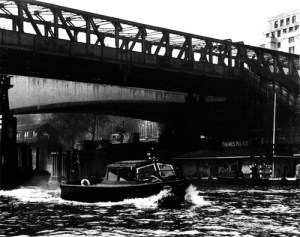
 The floating police pier under Waterloo Bridge, complete with police launch.
Henry Vollam Morton is one of my favourite authors. He was a widely travelled journalist and from the 1920’s through to the 1960’s he recorded his wanderings in a series of beautifully written travel books. His style was simple and elegant. He wrote short descriptive chapters about anything that took his interest and his legacy is a fascinating insight into a society that was rapidly changing from the old ways to the world that we know today. His books on London in particular, written between the wars, shine a fascinating light on a city that we will never see again.
 H.V. Morton’s “The Nights of London”
Morton seems to have had a particular affinity for the River Thames and its police force proved to be a rich source of material for him. He wrote about them on more than one occasion. In his book “The Nights of London” he recalls a visit he paid in the 1920’s to the floating police pier under Waterloo Bridge (now Tower Pier RNLI Station – the busiest in the country) and the conversation he had with the sergeant on duty. As a retired Thames police officer myself who served for many years at Waterloo Pier, I can almost feel the ghosts of serving officers past looking over my shoulder as I read his words – and my, how times change.
“I know of few more dramatic places in London than the Suicide Room of this police raft; the bed ready, the bath ready, the cordials ready. The little dinghy with the rubber roller on the stern, its nose pointed to the dark arches.”
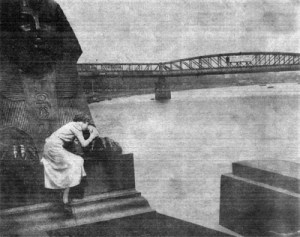 Waterloo Bridge in July 1937, as seen from Cleopatra’s Needle and complete with contemplative young lady (The floating pier can just be seen under the arch on the left).
The sergeant being interviewed recalled one particular rescue. “We heard a splash and we were there in a second. She was a good looking, nice spoken young girl but she did want to die. I have never seen anyone who wanted to die so much. She fought and told us to go away. What right have we got to come and interfere with her private affairs?” The sergeant went on to describe how the ensuing struggle almost led to the small boat being swamped by the river before they managed to land her at the pier at around 3am. This sad tale then took a twist that plainly amused Morton.
 The floating pier with Somerset House in the background
The sergeant described how they needed to put this attractive young lady in the bath to warm her up and apparently in those days a police matron needed to be summoned from Bow Street police station to deal with female patients. But, on this occasion, she was not available to attend. This left the police crew with an awkward problem – after all, the officers on duty were all unmarried men and not used to such jobs as undressing young ladies. Morton queried the sergeant that surely it would have been ok to assist the woman in these exceptional circumstances but our shy and bashful young sergeant was adamant, “You can’t be too careful, how did we know that she would not turn nasty for having her life saved and complain that she had been treated disrespectfully?”
 Thames Police rescue someone from the river (not the young lady in question!)
Fortunately for all concerned this tricky problem was resolved. It seems that the police pier in those days employed a “Handy Man” called Sam, and Sam was quickly summoned and informed that because he was the only suitably qualified man present (in that he had at some point in his life been married) He would have to undress the patient – a task he apparently performed without question.
Struggling to suppress his amusement that London’s finest, so often accused of callousness, could be so demure in its behaviour Morton completed his interview with a last few questions:
“And is that the end of the story?”
“Yes”
“Did she complain?”
“No, she didn’t”
“And why did she jump?”
“I think it was love”
As Morton left and walked along Victoria Embankment he wrote “I glanced back from the Embankment and saw the Thames heavy with the secrets it has carried to the sea these thousand years; and in the sky was a remote half moon lying on the curve in a ridiculous and careless attitude, as if London did not mean anything.”
This article was originally circulated as HVM Society Snippets – No.170 on 1st August, 2014



 H.V.Morton