After the armistice of 1918 the little Society of St Barnabas dedicated itself to a simple aim – “No grave on the Western Front, or farther afield still can be regarded as truly consecrated until it has been visited by its rightful warden”. True to its word, as soon as the Imperial War Graves Commission had completed its plans and the War Cemeteries were ready to be visited, for the next seven years St Barnabas set about contacting thousands of the relatives of the fallen and assisting them as they undertook the long pilgrimage until almost every known grave in what had been the Western European theatre of war during the conflict of 1914 to 1918 had been visited.
After that, only one duty remained. The Missing. For those thousands of soldiers lying in France and Belgium who had no known grave the idea was conceived of making the new Menin Gate, spanning the main eastern exit from the old town of Ypres, a memorial to those who had fallen in the Ypres Saleint and whose resting-places were “Known only to God”. The British Missing alone numbered some fifty-five thousand, their names engraved into the walls of the gate, representing almost every regiment and place in the then British Empire.
As a final gesture therefore, St. Barnabas staff and helpers arranged a last pilgrimage enabling seven hundred relatives of the Missing, mostly working women who had lost sons or husbands, to attend the unveiling and dedication of the Menin Gate in 1927. For some this was a severe ordeal, arrangements for travel and accommodation were not always ideal and many were elderly or infirm. But all the Pilgrims endured and returned safely having visited the land in which their men had fallen and seen their names set up in honour above the soil which somewhere contained them.
§
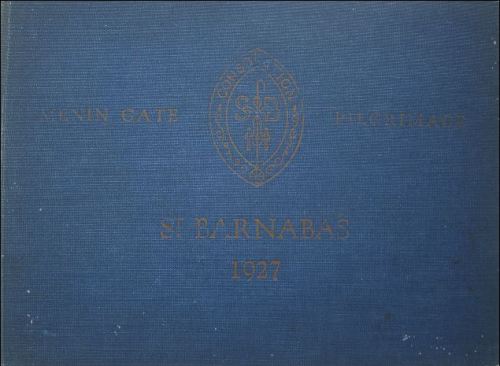
The passage above was adapted from the introduction to a 1927 publication entitled “Menin Gate Pilgrimage”. This rare volume (only 300 were produced) is roughly A4 size, bound with blue hardback boards and comprises fifty-two pages. It contains a number of articles giving an account of the final pilgrimage of some seven-hundred bereaved relatives to the unveiling of the shrine to the Missing, the new Menin Gate at Ypres, built by the British on land generously given by the Belgian people, through whose previous incarnation so many thousands of troops had marched to the trenches for the last time during the First World War. The publication was produced for those women unable, mostly because of age or disability, to attend the ceremony in person.
One of the most moving sections is entitled Threshold of the Empire (a title given to the Menin Gate during the war) and was written by HV Morton, originally appearing in the Daily Express on 25th July 1927. The full text is given below.
We will remember
They shall not grow old, as we that are left grow old;
Age shall not weary them nor the years condemn.
At the going down of the sun and in the morning
We will remember them.
Laurence Binyon
Niall Taylor, Glastonbury, Somerset, England
§
THRESHOLD OF THE EMPIRE
By H.V. Morton
There were 700 of them from the towns and villages of England. Each one of them has a boy whose grave is known only to God. There are rows of such nameless graves in every cemetery on the Salient. And the mothers had taken their first adventure in travel to see the great white gate on which, engraved among 55,000 others, are the names of their own boys.
In the early sunlight they stood at the station at Ypres holding little bunches of flowers from English gardens. They had guarded them carefully through all the hazards of a Channel crossing. Many a rose had fallen, many a snapdragon had wilted; but the mothers held on to them.
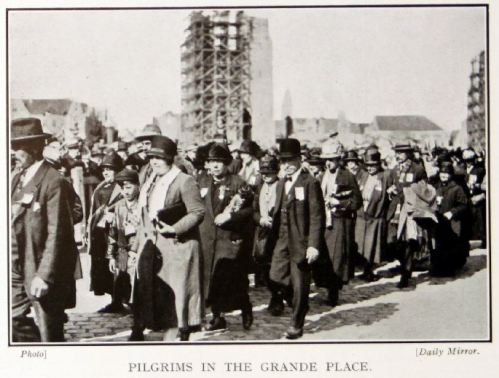
They looked so strange standing there on this foreign platform, with the ghost of an English kitchen behind each one, the ghost of a little street in England, the ghost of a little sitting-room where his picture hangs in a frame.
They were tired and hungry, and a little dazed by the foreign turmoil in which they found themselves. The first thing they noticed as they trooped slowly out in a long line was the old steam tramcar that runs to Kemmel.
“Oh, look!” said one. “That must be the ‘san fairy ann’ Tom used to tell us about!”
And they smiled as the old ‘san fairy ann’ gave its characteristic hiss and meandered casually to some remote objective.
So the mothers entered Ypres.
I shall never forget that sight. I think it was the most touching thing I have seen in Flanders. Their feet moved over the pavé of Ypres, and their eyes, straying from point to point, noticed just the same thing their boys noticed when they walked that same pavé many years ago – the dogs pulling the early morning milkcart.
How the boys hated that!
“Ah, you lazy blighters,” they used to say to the Belgian milkmen.
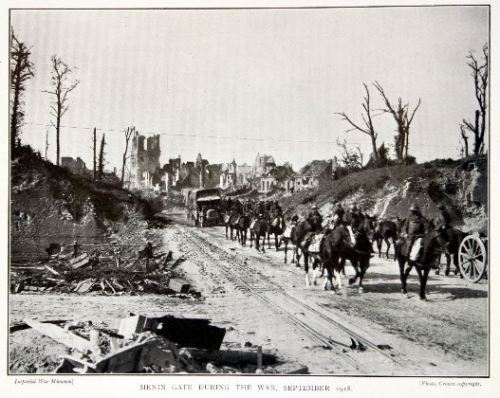
The Menin Gate during the war
Down a side-street they caught a glimpse of the shattered Cloth Hall. They remembered that. Tom had told them. They passed, without knowing, the site of the old dug-out in which Tom, with indelible pencil marks all over his lip, used painfully to begin a letter: “Dear Mother, …” And “Dear Mother” was walking through Ypres. How incredible that would have seemed to Tom!
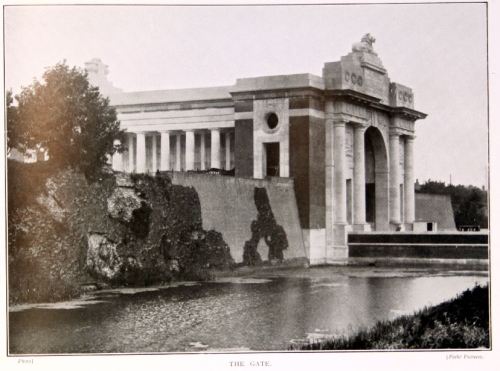
They went through the white Menin Gate, where already a great gathering had assembled. When they saw the long line of names on the stone – 55,000 names – tears came into their eyes. Tom was there, a little name on Menin Gate.
They sat in special enclosures, and watched the hot sunlight fall on the white stone and on the sitting lion over the portico who gazes out over the Salient. They thought he was a “nice” lion. He looked very proud.
They did not know that they were sitting on the road to Hell Fire Corner. Oh, Ghost of Ypres, what sight could amaze you more than that of “Dear Mother” so near to Hell Fire Corner holding a bunch of flowers from the front garden at home?
Then the ceremony began …
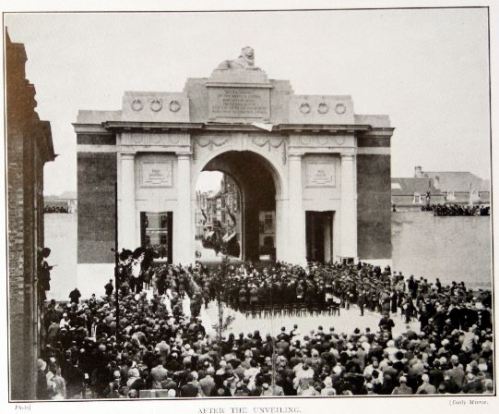
The buglers stood facing the Menin road, and blew their call towards the old front line.
No sooner had their last note faded than the pipers of the Scots Guards, standing outlined against the sky, high on the great rampart, played the lament, “The Flowers of the Forest,” and the wind, catching the sound of the wild Highland pipes, carried it out over the Salient, over the little dips and hollows in the green fields which were once trenches. There were dim eyes in Ypres to-day.
The sound of the pipes in that place was indescribable. One forgot the Menin Gate, the crowd, the very scene itself, and one’s thoughts went out into the open country, where the corn now waves and flowers grow, and one waited there with aching heart at the end; waited, it seemed, for some signal which should have come from out there along the Menin road.
The King and the generals went, the officers of state and the guards of honour departed, leaving the Menin Gate to the mothers of England. They came to it bravely, so bravely and calmly, holding their little posies of English flowers. All one could do was to put one’s arm in theirs, as if they had been one’s own mother, and, pointing high up on Menin Gate, spell out a name to them.
“That’s him,” they said, and cried a little.
Then they hung their appealing flowers on Menin Gate; little clusters of rambler roses, snapdragons, lilies, all from England. The wind of God will take the message of these English flowers and bear it over those little lost corners of a foreign field which are “For Ever England.”
(Originally circulated on 11/11/20 as HVM Society Snippet – No.269)



 The covers of three special editions
 H.V.Morton