Blue Days at Sea – a review

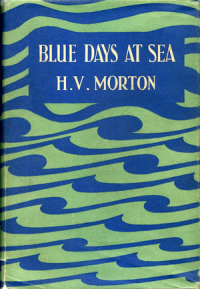
I have just finished reading “Blue Days at Sea and other essays” by HV Morton. While attending an enormous conference set in a magnificent edifice of concrete and glass, this slightly battered little book made perfect reading. It was a good companion to me in largely anonymous crowds as I carried it around to read between lectures and in coffee bars and restaurants, Morton’s highly readable style provided much welcome light relief from the subject matter at hand just as its slightly shabby cover contrasted pleasingly with the slick, plush interiors of the venue.

Blue Days at Sea, medium

The first thing I was looking forward to knowing more about was the unusual title. I had a vague idea the book was about the sea but was puzzled about the origins of the title. On opening the book I discovered that it is taken from a poem entitled “Romance”, by a young Robert Louis Stevenson. The first verse is given before the book begins:

I will make you brooches and toys for your delight
Of bird-song at morning and star-shine at night.
I will make a palace fit for you and me
Of green days in forests and blue days at sea.

“Blue Days at Sea and other essays” was first published in1932 and is dedicated “To All Who Serve on the High Seas”.

The book is a collection of short essays and vignettes, many of which are original, others having previously appeared in the Daily Express, the Sunday Express and the Daily Herald. It has nicely managed structure and form and is laid out in three broad sections – starting in serious and sombre mood in the section “About Men”, shifting into lighter gear for “About Women”, and offering a touch of introspection and a hint of the exotic as Morton travels far and wide across Europe and North Africa in “About Places”, until the final joy of coming home – “to a country which has no need to chain nailbrushes to a lavatory basin” – rounds off the collection.

The section titles are applied fairly loosley. In fact “About Men” concerns life in the Royal Navy, being an account of a period Morton spent as a journalist with the fleet, assigned to a ship referred to as HMS Impenetrable (although there is no reference an actual ship of this name anywhere to be found on the internet), initially anchored at its the base in the Cromarty Firth and later, during deep sea exercises and weapons training. These chapters clearly portray the great respect the author has for the personnel he encounters. We read his affectionate descriptions of the various manly goings-on and eccentricities he comes across, from the young “snotties” in the gun room to the god-like Captain on the bridge; all the time managing to convey a state of constant readiness, a willingness to face adversity and of extreme, calm and considered professionalism. These chaps, Morton seems to suggest, will get the job done, come what may, and still be back in the ward-room in time for a tot of rum and a round of “Priest of the Parish” before bed-time.

After the thrills of high speed manouvers in the Atlantic we are taken to the other extreme where, in the languid setting of a mediterranean naval base, the reader is given a touching account of the death and burial at sea of humble, loyal, Stoker Davis. Again Morton paints a picture of reserve and British stiff upper lip –

“‘Hullo! Where’s the wedding?’, asked a friend, nodding at the flowers.
“‘It’s Stoker Davis,’ replied the engineer commander, finishing his drink. ‘Dead.’
“‘Bad luck… What are you drinking?'”

HMS Dreadnought on manouvers

HMS Dreadnought on manouvers

The next section, “About Women”, while tending to the patronising as might be expected in a book of its time also reveals refreshingly modern attitudes in places. “The Wife” for instance, while describing the subject’s love affair “with a dress in a shop window”, also has a swipe at the husband as he is taken to task for not appreciating the work performed by his better half. The author also expresses disapproval of the husbandly hold on the purse strings which would have been the norm at the time. In another chapter Morton describes a business woman as she delivers financial advice to a male client to the accompaniment of simpering comments from a couple of “chaps” at the next table, “By Jove, pretty hot stuff that!”. To be fair, this isn’t Germaine Greer but in its day it must have been a bit of a revalation, particularly coming from a male author.

The reader is treated to a touch of pathos with the mysterious “Woman Nobody Knows” and a little light humour with “The Bad Girl” (a disconcertingly modern-sounding account of 1930’s “yoof”) and “The Head Huntress” ruthlessly stalking the jungles of London Society in dogged pursuit of a suitable marriage for her daughter.

The final section, “About Places”, starts in the tourist office with an account of the “Man of the World” who works there (and isn’t all he seems!), before Morton is off, across the globe with tales of his travels as he visits Paris, sees snow in Rome, rides across the Sahara on Ferdinand the Fiery Steed and encounters a link with the past – a proud man fallen on hard times – as he relates the touching story of Mr Snap in Cairo. There are several chapters concerning Rome, including an account – of interest to any Scot worth his salt – of a visit to the final resting place of Charles Edward Stewart, Bonnie Prince Charlie, at his tomb in the Church of St Peter. Morton gives a moving account of the life of the Young Pretender, contrasting the romance and chivalry of his youth with his sad fall from grace in later life. The romance of House of Stewart, he observes with disconcerting insight, is “the appealing romance of misfortune wedded to good looks”.

Then, after stopping off for a spot of night fishing in the seas around Capri where he is horrified by the throes of an expiring calamaro (or squid), it is back home once again with a loving homage to homecoming in the form of an account of the Dover to Victoria train as it takes Morton back to “reliable” London, a city populated entirely by “splendid men and beautiful women”. He is realistic about the fleeting nature of such feelings of elation after long weeks spent travelling abroad but nevertheless he notes the railway platform at Dover harbour as a symbol of something he would be willing to fight to defend in the event of war. I wonder if he could have guessed that only a few short years later he, and millions of others, would be called upon to do just that.

“Blue Days at Sea and other essays” is an engaging assortment, demonstrating Morton at his strongest as he explores a wide range of moods and emotions, all the while rooted in the everyday happenings of the world of the 1930’s. Once again Morton’s exquisite use of pace, structure and language reveals intimate details of life overlooked by grander, more self-important accounts elsewhere, and even today, after the best part of a century, we can still delight in it.

Niall Taylor, Glastonbury, England
5 March 2013

ship 02 silhouette copy small

7 Comments

Filed under Book reviews, HV Morton, Quotations

H.V.Morton – Our Fellow Men: A Review By Jim Leggett

(This post originally distributed as – HVM Literary Notes – No.117)

H.V.Morton – Our Fellow Men

A Review

By Jim Leggett

During a flight from Miami to Curacao in 1992, colleague Mike McDonough, a former Reuters reporter, mentioned his enjoyment of HV Morton’s volumes as, from his pocket, he produced a small book.

“‘Our Fellow Men’ – it’s a potpourri, on the daily lives of tradesmen, dustmen, ploughmen, chimney sweeps, even the milkman… have you read it?” he asked.

Our Fellow Men

OUR FELLOW MEN
By H. V. Morton

Methuen & CO. Ltd.
36 Essex Street W.C.
London

First published May 7th 1936, cover art by EA Cox

I’d never heard of this title let alone read it.

Back in Florida a week or so later I stopped by Mike’s apartment in Lantana, a sleepy seaside town some sixty miles north of Miami. Over a zesty Cuban coffee and sandwiches, he thumbed the pages of his hardcover copy with its slightly faded frontispiece, otherwise in pristine condition. He told me he’d picked it up in Manchester, his UK hometown. “Time to pass it on…” he added, giving the book to me.

“Our Fellow Men” is a Pepys-style contemporary (mid 1930’s) history, insights on ordinary folk, men and women, revealing day-in-the-life-of insights from a wide variety of intriguing characters, the like of which HVM had an uncanny knack of turning up. Add Morton’s wry historical observations, Presto! – Another enchanting read. I particularly enjoy being able to delve in anywhere, picking whatever occupation takes your fancy.

* * *

London taxi drivers, circa 1936, were issued from sixty to seventy police summonses a week, for going too slowly. Not keeping up with the normal flow of traffic was an offense, arbitrary fines ranging from 2s 6d in one court to 5s at another – for the identical “crime”. Taxi drivers were paid thirty percent of the gross meter taking, or 6s from every £1 pound collected. Morton interviewed a dozen drivers, discovering their take came to “rarely more than a £2 10s or £3 pounds a week job”. They received no wage; theirs was in an uninsurable occupation, in that if he is out of work, he cannot receive unemployment benefits. In short, taxi driving at that time was not profitable.

We meet, too, George, the cinema projectionist, the man picture theatre patrons never see – the man behind the film. Working in a fireproof room known as a “box”, two projectors, a side lantern and a spotlight are under his command. Morton notes: “It is thanks to George’s skill and vigilance that Greta Garbo comes over at the right speed, and it is due entirely to George’s alacrity that the heart-throbs change swiftly and smoothly to the welcome tempo of Walt Disney’s fertile brain”.

We learn that the moving picture era began in 1824, when Peter Mark Roget lectured before the Royal Society in London on the subject of moving objects and the law of vision. Morton notes the first form of moving picture was a card with a bird painted on one side, and a cage on the other, which – when suspended from a string and rapidly revolved – gave the illusion that the bird was in the cage.

Under George’s skillful hands something like seven miles of highly flammable film flickered through the projectors in his long days work. His first duty was to see the celluloid film did not catch fire…and indeed they did. As a boy I recall fire brigade bells clanging as they raced to the Star Picture Palace in Glasgow to suppress a smoky projection “box” fire.  The projectionist rarely sees the movie, “I don’t pay much attention to them! Sometimes I look at the news, especially Monday’s Cup-ties matches.” George says, closing the interview with “Well, I’ll be getting along home. I believe I am married….”.

Then there’s Bill, an insurance salesman, who knocked on some fifty doors during his morning’s round, collecting money on what his company called life insurance policies. Morton noted they are really “death policies”. The shame of a parish (pauper) funeral was so ingrained in the populace, they would forgo the smallest personal luxury to meet their meager weekly premium, their insurance man oozing charm while persuading them “You want to the right thing for dad, now don’t you? Have you got the money for his funeral? You’ve got to think about these things”.

Bill confesses that 90% of the money he so painfully screws from starvation incomes goes right into the pocket of the undertaker.  In that respect not much has changed – except you have to take a second mortgage to afford a funeral today. (In irreverent determination to cheat the mortician, I’ve donated my well-travelled corpse to some medical procurement enterprise, for free):

Whisky toast crop small

On the lighter side Morton spoke with Jack, a newsboy. Evening newspapers, which supply London street sellers with a living, during the 1930’s sold by the “quire”, twenty-six copies, for which he paid 1s 6d. A quire, strictly speaking, is twenty-four, but the two extra copies – it used to be three – were thrown in as the seller’s profit. An 8d profit on the sale of every twenty-six copies sold. We learn of an assortment of street vendors; Sunshine Runners, who hawk papers only when there was something to sell – football results and the like; Tappers, crooks who got in touch to “tap” you, often pretending to sell papers to inebriates; Movie Men appeared to sell only one quire, earning them admission price to the pictures. Jack tells Morton he can earn £2 10s to £3 a week by selling newspapers, as long as his pitch is not invaded by pirates who swoop down from nowhere with a football edition.

* * *

In the space of 171 lively pages, thirty extraordinary ordinary Londoners are resurrected, alive once more as HVM so deliciously captured them. He divulges what they did to feed themselves and their families, reveals how many hours a day they toiled and, of paramount importance, the wages they earned.

Says Morton, “I have also the feeling that should some curious person pick this book from a penny box in the year 2036 A.D., he would be interested to know the wages of a dustman in 1936, or the money earned by a taxi-cab driver in the London of Edward V111”.

… I’ve sent my copy on to Sean Connery [see footnote], who was an Edinburgh milkman long before “shaken, not stirred” took the place of “One pint or two?”.

With best wishes,

Jim Legget, The Bahamas
March 2013

§

FOOTNOTE:

In keeping with HVM’s observation on income, when last I visited with Sean Connery at his home in Lyford Cay, Bahamas, we spoke of his early job as milkman – when he had his own (employer’s) horse and cart.

view;_ylt=A0PDoQyl4AJRAg0A6XCJzbkF

St. Cuthbert’s Dairy, in Edinburgh, delivered milk by horse and cart well into the 1980’s

On opening a weighty Volume One of “Old and New Edinburgh” by James Grant, published in 1883, Sean took amused note of a small rubber-stamp flyleaf imprint:

J.M. Cameron
26, Melville Terrace
Edinburgh.

“Christ! I used to deliver milk to that address…I knew that terrace well” he declared.

In his book “Being a Scot”*, a copy of his first milkman pay slip reads;

Date 20-7-1944;
CONNERY  Thomas. S. #26246.
St, Cuthbert’s Co-Operative  Dairy
Fountainbridge, Edinburgh

His starting salary was one guinea, or twenty-one shillings (£1.05p), a week. He writes; “the horse I groomed was a Highland garron pony called Tich and I loved her dearly.”

From his modest pay packet, Sean relates how he bought Tich rosettes and chains – which looped down from each ear, “along with a martingale, or bracelet, which hung down her front.” He was so proud of Tich he entered her in the annual horse-and-cart competition for the best-dressed horse and she won a Highly Commended!

* “Being A Scot” by Sean Connery with Murray Grigor, Published by Weidenfeld & Nicolson 2008, pp18-19

Leave a comment

Filed under Book reviews, HV Morton

Mortonian Meanderings: “In Search of Cuckoo-Land”

Walking in to work each morning gives me time to think, to get away from the ubiquitous Information Technology that surrounds us all these days.

Today I am musing on some recently aired, light hearted grumblings about the country I live in and, specifically, whether images, conjured by authors like HV Morton, merely feed impressions of an idealised fantasy world (let’s call it “cuckoo-land”) to readers with a rose-tinted view of somewhere that is always just around the corner, forever out of reach.

IMG_3356 crop small

Cuckoo-land?

Is it right or wrong to fuel this alleged delusion, does such a delusion even truly exist? It’s certainly food for thought.

Locking the front door behind me, I step out onto a road which bears the name of an empire whose citizens, some two-thousand years ago, walked the same route and allegedly grew vines on the now frozen slopes above, and moored boats in the valley beneath, before the marshlands were drained to make way for productive green fields. Many a time, in the hope of uncovering Imperial Artefacts, our family has staged excavations in the front garden, only to encounter broken pipestems, fragments of pig trotter and shards of Edwardian crockery.

I am most envious of my daughter who I have just packed off, blinking and pale-faced at this unaccustomed hour, on a school trip to visit what the English refer to as the Mother of Parliaments, at Westminster. I wonder if I reminded her frequently enough to take plenty of photographs which I can purloin for future Morton-related projects?

I trudge on, swathed in warm and weatherproof garments, the cold nipping fiercely at any extremities injudiciously exposed to the elements, my breath billowing ahead of me. I imagine myself to be a stealthy ninja warrior, only my eyes visible, as I stalk the silent streets in search of my hapless quarry. To anyone with a more rational outlook I am more like the Michelin Man, after he’s let himself go a bit.

This morning the sky is clear and blue, something I’m sure I haven’t seen for months. Everything – red-brick houses; old, stone bridges;  even the slumbering, hollowed-out shells of former industry – is given a pleasant hue by the warm colours of the rising sun.

There is a smooth, flattering cover of frost over field, hedge and fence, lending an unblemished, slightly unreal quality to mundane things – even parked cars are transformed into works of art, courtesy of this freezing makeover. Looming out of the low-lying mists along the banks of the meandering river below are the tops of the highest trees, groping upwards, like skeletal hands; and tall, disembodied chimneys from a lost industrial past – which JB Priestley and HV Morton would probably have spat teeth at and ignored respectively – but which now, softened by the passing of time, are part of our landscape, history and culture and have become as familiar as old friends.

IMG_0278 copy crop med

As my walk continues, I realise the everyday world around me has been elevated to Turneresque heights – a dignified and distant silvery etching of trees, higgledy-piggledy houses and little hills which is suddenly astounding. I try to imagine it captured, frozen and in a frame, gracing the most exalted of art galleries.

It is part of the human condition that only after months of mud and mire, of rainfall and floods are we able to appreciate mornings like this – without the proverbial “rough”, we cannot enjoy the “smooth”. We need the contrast. But it’s difficult sometimes to avoid becoming preoccupied by the “rough”. It requires effort to appreciate what we have on our own doorstep, to be able to count our blessings and “see things with new eyes” – as those infuriatingly smug “New-Age” types are wont to say. It is too easy to become bogged down with the ordinary, the minutiae, the every-day blandness.

Misery and depression, death and destruction, murder and mayhem all sell newspapers (or their e-equivalents) far more readily than good news. So we have to look hard for that good news – the little chat with Tony the taxi driver down the road as he tells me his cat is much better now, thanks; a chance meeting with a grumpy lorry driver in day-glo yellow, who has probably been on the road since the crack of sparrows’ knee-caps, but who can still be persuaded to raise a smile when the driving skills of those Kings of the Road, the artic. drivers, are remarked upon in complimentary manner.

IMG_3564 crop

“In the early morning before the sun is strong, a man standing on this hill looks down, not upon the neat flat pasture lands of the Vale of Avalon, but upon Avalon, an island again, rising from a steaming sea of mist… the mist rises from the fields as if it were the ghost of that sea which covered the valley in the age of legend. In the cold wind that runs before the dawn a man looks down upon this faint, moving veil, watches it writhe in spectral billows over the land, steaming upward in faint lines in the high places and so exposing the darker objects beneath which, in this hushed hour, seem almost like the bones of heroes, or the hulls of legendary barges sunk in some old poem.”

HV Morton, “In Search of England”, chpt 6

This country is different – it couldn’t be anything else (nor should we truly wish it to be) – from that of nearly a century ago. It is no longer (if it ever was) the place described by Morton’s amiable narrator, as he bowled along in his little car. True, nowadays bad things happen and times are tough, but they are not nearly as bad or as tough as they were (and were shortly to become) in Morton’s day, regardless of the alluring optimism of his travelogues. This country is still a pretty good place to be, if one can rise above the petty clamour as HVM did in his day, and I would still recommend it highly as a place to visit or to stay. We live in a cynical age, when it’s difficult to admit to being content with one’s lot, and we are all much more inclined to grumble than to eulogise. One book which claims to be a modern successor to Morton is in fact entitled “Mustn’t Grumble”, although in it, by all accounts, the author does indeed grumble, quite a lot.

If there is a heaven (and I’m yet to be convinced), it may not just be be a place where things are pleasant and comfortable, but one where we are able to appreciate that which is pleasant and comfortable without the need for the unpleasant and uncomfortable – now that would be a trick!

Until then I’ll continue to take life as I find it, one day at a time, and endeavour to appreciate the things around me more.

As I arrive at work I see the daffodils in the flowerbeds around the front-door are in bud – pioneering spears of lime-green, courageously poking out of black, frozen soil – Spring is in the air. It won’t last of course!

Now I need to hope I can find a spare moment, when I can sit down to catch these fleeting snippets of thought before they are snowed under with everyday normality – amateur writers, who needs them!

Niall Taylor February 2013

5 Comments

Filed under HV Morton, Quotations, Travel

HV Morton on Whisky

Originally distributed to the HV Morton Society as: HVM Society Snippets – No.151

IMG_5061 copy small“The whisky had uplifted them… It had given them wings.”
(from “In Scotland Again” chapter 6, section 9)

Product placement is nothing new. John Mills was sipping his “Ice Cold” Carlsberg in Alexandria a lifetime before James Bond inexplicably started flashing his omega ® watch and nokia ® phone – logos placed strategically for all to see – across the big screen and mysteriously eschewing his traditional vodka Martini (shaken, stirred or otherwise), in favour of the same well known (if somewhat out of character) Scandinavian lager, favoured by Sir John.

Surely, such mundane contrivances would have been beneath Morton. Never the less, it has occured to me, if he wasn’t being sponsored by Talisker then he was missing a trick!

Morton wrote his books in the days when a malt whisky was something very special, to be savoured and enjoyed, as one might a rare work of art. The drinking of a single malt was a mark of distinction; hoi polloi were condemned to make-do, as best they could, with mere blends.

These days, with any number of malts so easily accessible from the shelves of the nearest supermarket, something of the mystique is being lost. Thus it is a wonderful reminder of times gone by to read of Morton’s reverence for what is clearly his favourite whisky – with its hints of peat fires and sea salt and a strangely endearing, almost medicinal, tang.

It is Burns’ night, and many a lover of Scotland – adopted, native or otherwise; at home or abroad – looks forward to raising a glass to celebrate the brief but colourful life of their country’s great national poet, Robert Burns. I thought, on this occasion, a passage from Morton’s “In Search of Scotland” might be appreciated. It is from chapter 10, section 5, after the narrator has offered a lift to a wandering highlander, soaked during a mountain storm, on the road to Crianlarich. As the weather lifts, the sun comes out, a little gold cloud dances over the head of Ben Dorian, and Morton writes:

“I remembered that I had in my bag a bottle of Talisker whisky, that remarkable drink which is made in the Isle of Skye and can be obtained even in its birthplace only with difficulty. This seemed to me an occasion. When my companion saw the bottle of Talisker he ceased to leap about and, becoming solemn, he said:

“’Talisker? Ye don’t mean to open the bottle? It’s a shame to waste it; but, man it’s a grand whisky!’

“We settled down.

“He had a tin mug in his rucksack; I had one of those idiotic so-called drinking cups which you place firmly on a stone with the result that the whole thing telescopes and spills the liquor. We poured the amber-coloured Talisker into our mugs, and descending to an amber coloured burn in the heather we let a little ice cold water into the whisky.

“There is, so it is said, a time for everything, and the time for whisky is after physical fatigue in the open air among great mountains. This Talisker drunk below the great, windy clouds in the shadow of Ben Dorain was different from the whisky which a man drinks in his club as Lachryma Christi drunk in the shadow of Vesuvius differs from the same wine in Soho. This drink filled us with good nature and enthusiasm.

“My friend, perched picturesquely on a stone told me a lot about himself. He was something in a city. He always spent his holidays in his native highlands. He loved to wear the kilt for two to three weeks and to run wild in the heather. As the Talisker burned in him it lit fires of patriotism, and I listened with delight as he spoke of his love for the hills and the glens and the peat-hags and the great winds and the grey mists.”

Talisker

I like to think, just occasionally, the odd bottle of that “amber-coloured Talisker” might have found its way to Morton, sent from a grateful distillery owner across the water, in return for services rendered. Call it part of the angels’ share.

“Freedom, friendship and whisky gang thegither” (Robert Burns).

With grateful thanks to Jim Leggett, of the The Bahamas

With best wishes,
Niall Taylor, Glastonbury, Somerset, England
23 January 2013

Leave a comment

Filed under HV Morton, Quotations

HV Morton the Photographer

Originally distributed as: HVM Literary Note – No.116

My Leica and I 150dpi crop small

It isn’t always widely appreciated that HV Morton was a keen photographer, taking many of the photographs which featured in his books himself. This passion was also shared by his second wife, Mary who took many of the photographs included in his works concerning the Middle East.

I received an email on this subject a while ago, in the heady days immediately after the change of coordinatorship – when my mind was suffering information overload from juggling membership lists, email addresses and ideas for future articles – from HVM Society member and professional photographer, David Jago. Having had this for a while on the back burner, so to speak, I thought now would be a good time to put the information out as a bulletins to members.

I love connections, and on re-reading David’s piece in preparation, I found there was a little bell ringing at the back of my mind. This in turn, after a bit of thought, led me to look even further back, to a much earlier email from then the coordinator, Peter Devenish, following a remark I had made about a cover of one of Morton’s books on the home page of the web-site:

Dear Niall,

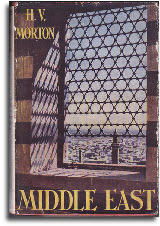
I’m sure you know [I didn’t! – NT] that one of your favourite jacket designs, namely that for several editions of  “Middle East”, was taken at Aleppo by HVM. I agree, it is a superb design.

Cover Middle East

Did you know, though [I didn’t! – NT], that HVM’s photo was first published in an article he wrote for Leica News and Technique, No.26, March-April 1937; published by E. Leitz, London. The article was entitled Travel with the Leica.  Interestingly, the illustration on the dust-jacket of the book is the reverse image of the photograph printed in Leica News and Technique.

Aleppo 1

All the very best,

Peter

And this brings me to the later email from David:

Hello Niall,

Just a note concerning HVM. I am an agency photographer and mainly use a Leica camera.  Recently I discovered in a bookshop a second hand publication titled “My Leica and I”. Published in English and printed in Germany in 1937, it contains stories by well known people together with photographs taken by them in a variety of countries. The first article, and there are 18 in total, is by HVM describing how useful he finds his Leica camera on his travels, together with details of the apertures and speeds used.

Prior to finding this book I had rather assumed that he obtained photographs for his books from press agencies but it now seems that this was not always the case.

Best regards,

David

I wrote back, thanking David and congratulating him on his wonderful find. That has got to be every book-lover’s dream, surely – to find a copy of an obscure and sought-after volume by sheer luck, whilst browsing the shelves of the local bookshop (I have a slightly singed copy of “A Stranger in Spain” which has always been special to me for that very reason).

David kindly sent me copies of the cover of this publication (as seen above) – featuring a very arty, bohemian type squinting earnestly through his viewfinder – and of Morton’s article, which it contained. Thus I discovered the title of the article was also Travel with the Leica.

That’s when the little “connections” bell started ringing in my head and I thought first, of Peter’s earlier communication (above) and second, of a previous HVM society bulletin – Literary Note No.22 to be precise – also by Peter, about this same publication where a transcription of the text of Morton’s article, and both the photos by HVM (The Gorge at Delphi and Bedouin Girl), can be found.

So it appears that the article, which, according to Peter, originally appeared in Leica News and Technique, No.26, March-April 1937, was, later that same year, also included in the hardback volume discovered by David in his local bookshop – the full title of which is “My Leica and I – Leica Amateurs show their Pictures”.

I was so intrigued by this little known example of Morton’s works that I have since (more by luck than judgement) managed to acquire a copy for myself. The publication is a well presented hardback, featuring articles by a variety of authors on diverse aspects of how best to use the Leica; including at the theatre, at the zoo, with the family and, amazingly, while skiing, and climbing in the Himalayas. A section at the back is given over to 152 pages of photographs by the authors, including Morton’s two contributions (the townscape from Aleppo is, unfortunately, not included in the work).

The photographs are all wonderful, but of particular note is the one on page 50 which features an aerial view of the Cathedral of Santiago de Compostella, North Spain, by Hans von Schiller. When I first looked at it, I thought it was somewhat spoiled by a massive shadow occupying most of its centre until I realised, from the shape, that this view had been taken from the gondola of an airship  – what a piece of history!

Other pictures have been taken all across the globe and feature landscapes as well as candid portraits of people at work, wild animals, people at sport and play; and some beautiful close-up work including studies of insects and snow-flakes – all giving an insight in everyday life in the 1930’s. My personal favourite is this one, entitled “Curiosity“, from the article entitled “The Leica in Family Life“, by Swiss photographer Dr Walter Weber:

Curiosity colour - mod

So, there we have it, another piece of the jigsaw of HV Morton’s life and works, and a side of him which gets little attention, even though photography seems to have been an important part of his life. In fact, according to Literary Note No.22, Morton once confided, in a letter to a friend, that he would have preferred to have been a photographer than a writer. Thankfully for us, he refrained from developing this idea further.

There are many more examples of Morton’s photographic works to be found though, if one looks carefully; and in part two, Stan White gives us a further insight into HV Morton, the Photographer.

With grateful thanks to David Jago of England, and Peter Devenish of Australia.

Best wishes,

Niall Taylor, Glastonbury, Somerset, England
January 2013

Leave a comment

Filed under HV Morton

Merry Christmas!

Originally distributed as HVM Society Membership Notice 2012-12-24

Just a short note, dashed off between rain, floods and disastrous mince pies, to wish all admirers of HV Morton and book fans generally, wherever you are and of whatever religious persuasion you may be, a very Merry Christmas and a Happy New Year.

I tried hard to find a suitable quote from HVM about Christmas or winter, but couldn’t find anything which struck quite the right note. I did however come across this celebration, by Morton, of  the “bookmen” – which is to say “the book readers, the book hunters, the book tasters, the book maniacs…” who haunt the bookshops of the bustling Charing Cross Road, London – that captured the mood and I thought might be appreciated by librarious persons during the festive season:

“Lost to the world that touches their elbows as they stand there, the bookmen pry and pore into the books, looking and seeking and sometimes even finding. I love to remember the hours I have spent there, perhaps on spring mornings, sometimes in winter, oblivious of cold feet, when the shop doors open to the warning ping of a little bell, and often in the evening when the lamps have been lighted and the titles shine out splendidly in gold, behind the plate-glass windows.”

from “In Search of London”, 1951, chpt 10

Finally, anyone who, like me, will be raising a glass of  the old uisge beatha at the turn of the year can take comfort in the knowledge that, according to this web-site, the top three books to read while drinking whisky are all by HV Morton.

Sláinte mhaith!

With seasonal best wishes,

Niall Taylor
24 December 2012

2 Comments

Filed under Christmas, HV Morton, Quotations

Armistice Day

Armistice Day Commemoration

(This was originally posted to HV Morton members as HVM Society Snippets – No. 145)

In February this year, in King’s Lynn, Norfolk; Florence Green died peacefully at the age of 110. A modest woman, she had worked much of her life at a local hotel and during her spare time was heavily involved with the British Legion – knitting clothes, blankets and toys for children. Before her marriage at the age of nineteen, she had also served as a mess steward in the Women’s Royal Air Force and, with her passing, the world lost its last living link with those people who served in the forces during the First World War.

Remembrance day is approaching. A commemoration of the day when, after more than four years of continuous warfare and roughly 20 million dead, the guns fell silent across the battlefields of Europe and the World on the 11th hour of the 11th day of the 11th month in the year 1918.

The hope at the time was that this had been the war to end all wars. Surely, after such madness, the carnage would never be repeated? We know now this was in vain, and, little more than two decades following the signing of the armistice at Compiègne in France, the conflagration ignited again. It seems the urge to warfare may simply be part of the human condition.

Twenty-six years after the excerpt below, in his 1951 book “In Search of London”, HV Morton, in somber mood, described post-Second-World-War London as a city “of jagged ruins and hatless crowds”. The bare heads of its populace were symbolic of a people who were, “graver and sadder”  than before – people, Morton wrote, whose courage had been “expended in many years of air warfare… the air raid wardens, the fire watchers, the firemen”. Knowing how the hopes for peace in the years following the Great War had been so thoroughly dashed, Morton briefly considered the possibility of yet another, third world war in the new atomic age.

The following contemplation of the Cenotaph in London is from Morton’s “The Heart of London” and was written only six years after the last shot of the First World War was fired:

§

The wind comes down Whitehall and pulls the flags, exposing a little more of their red, white, and blue, as if invisible fingers were playing with them. The plinth is vacant. The constant changing trickle of a crowd that later in the day will stand here for a few moments has not arrived. There is no one here.

No one? I look, but not with my eyes, and I see that the Empire is here: England, Canada, Australia, New Zealand, South Africa, India… here — springing in glory from our London soil.

*    *    *    *    *

In a dream I see those old mad days ten years ago. How the wind fingers the flags…

I remember how, only a few weeks ago, as a train thundered through France, a woman sitting opposite to me in the dining car said, ‘The English!’ I looked through the window over the green fields, and saw row on row, sharply white against the green, rising with the hill and dropping again into the hollows — keeping a firm line as they had been taught to do — a battalion on its last parade.

The Cenotaph and no one there? That can never be.

§

With best wishes,

Niall Taylor (originally distributed 2nd November 2012)

HV Morton Society members who would like to, can read Morton’s 1927 account of a pilgrimage of 700 mothers of the fallen to the Menin Gate at Ypres in Belgium in the on-line archive.

For an explanation of the connection between the Cenotaph in Whitehall and the grave of the unknown soldier in Westminster Abbey, have a look at the British Legion website.

Leave a comment

Filed under Armistice day, HV Morton

The Catholic Herald’s 1936 review of “In the Steps of St Paul”

The Catholic Church has always had a commitment to the preservation of literature. This continues to this day, to our great benefit, in the transcripts of the London-based Catholic Herald – its entire content, from 1935 to the present day, having been scanned, digitised, tagged and extracted to give a fully searchable archive. What an invaluable resource this is for anyone interested in modern history, particularly since currently the archive remains free to view.

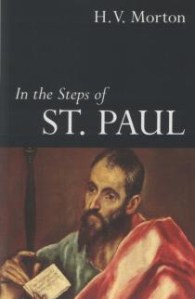
The cover of the 1936 edition of “In the Steps of St Paul”

You can imagine my pleasure when I stumbled across a review, from 1936, of HV Morton’s “In the Steps of St Paul” entitled “Follow H. V. Morton — But Read St. Paul” by one of The Herald’s regular contributors, Father CC Martindale SJ (1879-1963) (SJ stands for the Society of Jesus, which is to say the Jesuits). Fr Martindale was a Catholic convert, Oxford scholar and renowned Jesuit author.

The transcription suffers only slightly as a result of minor inaccuracies in the Optical Character Recognition process and the digitised text is easy to read. To eliminate any doubt about the actual content, however, the original, scanned versions of the pages are provided for reference alongside the transcript.

The tone and language used in the review is delightfully “of its time”. Martindale opens politely enough with the hope that Morton’s book will sell well, but then launches into some fairly outspoken criticism. There is none of the non-judgemental, cautious, oblique (some would say sly) language we are so used to seeing in literary criticism these days. The Reverend Father says what he feels, and no mistake: Morton made his journey in the wrong order, he stuck too closely to his chosen title, he excluded the epistles and, what’s more, Martindale suggests Morton may not even be in possession of the sort of mind required to assimilate all the literature essential (in Martindale’s view) to the author of such an undertaking.

Having said all this and hinted at, “many other details we might have challenged” Martindale, rather euphemistically, “proceed[s] to recommend whole-heartedly every part of this book which is strictly true to the title”. And in truth the author does appear pleased with many aspects of Morton’s book as an exposition of St Paul, surely the greatest of all Christian missionaries. Martindale approves of Morton’s “light hearted” tone and his description of “Arab proverbs; quaint anecdotes; adventures anxious and comical” as they are “lavished upon us with profusion”.

HV Morton’s “In the Steps of St Paul” is still in print. For further details click the thumbnail to visit Methuen’s website.

In his closing paragraph, Fr Martindale, ironically sticking extremely closely to the title of his article, impresses upon readers they should certainly follow Morton “In the Steps of St Paul”, suggesting enthusiastically that they will be “astonished, amused, touched, awestruck, frightened, inspired”, but they should read St Paul.

I, in turn, would recommend that you read Martindale’s article! It is an enlightening piece of contemporary writing and gives a view of how Morton and his works were perceived by some at the time. Interestingly, it also tells us that the Church was not unequivocally happy with Morton’s writings on the Holy Land; something which these days, is difficult to comprehend when religious bodies seem to be falling over themselves for the type of popular appeal that Morton was able to lend.

Niall Taylor 5th November 2012

Leave a comment

Filed under Book reviews

HV Morton: Travelling into the Light

In the Steps of Morton in the Moor
(or, “I’ve had a ride in a Bullnose Morris!”)

being the story of the recording of a BBC radio 4 programme presented by John McCarthy, produced by Stephen Gardner, entitled: “H V Morton: Travelling into the Light”, broadcast on Friday Sept 21st 2012 at 11.00am (originally circulated as HVM Society Snippets no’s. 140a and b).

Anyone who wishes to hear the broadcast can do so, until roughly September 2013, using the BBC’s “Listen Again” facility on this link: www.bbc.co.uk/programmes/b01mqr4t

§

Uncle Tom Cobbleigh and all

Prelude:

On the 22nd of June I was approached, via the HV Morton website, by Stephen Garner of BBC Radio 4 who announced he was making a programme about HV Morton. He said the broadcast was intended to “to retrace one of Morton’s journeys as featured in the book In Search of England and mark the differences which have taken place in England since its publication whilst reflecting on his memoirs and diaries, discovering the life and personality of this intriguing and charismatic man whose influence continues to this day“. Cunningly, he also made complementary remarks about the web site and suggested it would be useful to have me along on the recording which was scheduled for some time in August. Well, how could a lover of both Radio 4 and an admirer of Morton resist such an opportunity (or indeed, such flattery) – I agreed to help by return of post.

In subsequent correspondence I discovered that the programme was to be presented by John McCarthy, the well known journalist who was also a lover of Morton’s writings and of Devon, which he had visited many times as a child. As we got closer to the time of the recording the date was set for Tuesday the 21st of August, when we were to visit 3 locations in Devon to recreate parts of chapter 5 of “In Search of England”. The actual broadcast was finally scheduled for 11.00am on the 21st of September.

I was asked if I could track down a Bullnose Morris car of the sort driven by Morton which could be included in the programme as this was an aspect of the journey which they wanted to explore – and a recording of its Hotchkiss engine during an interview would make for excellent radio!

This task proved somewhat tricky, almost impossible in fact, as I was told repeatedly by everyone I asked that the amount of notice was insufficient and besides, this was the height of the motor show season when many owners would be tied up with other things. Finally however, and to my great relief, Malcolm McKay of the Bullnose Morris Club, showing incredible patience in the face of my repeated pleadings, came up trumps by personally phoning the few members in that area who didn’t have email so hadn’t been contacted earlier. It was one of these, the last on his list infact, who finally answered my call.

I managed to book the day of the recording off work in order to visit each of the three scheduled locations to get a feel for how the programme was to be made to mark the occasion for the HV Morton society by giving this account. I had also been asked to take part myself by giving an interview.

I arranged a photographic unit (my wife Alison, to whom I am incredibly grateful, acting above and beyond the call of duty!) to record the day for posterity and before we knew it the day had arrived.

The day arrives, controversy at Widdicombe:

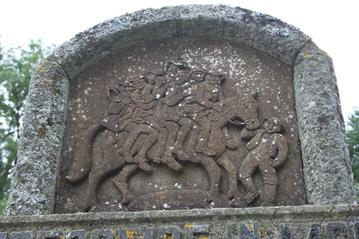
“… I saw Widecombe! A line of tiny, white thatched cottages lying in luscious hedges, a hollow full of thick green trees, the tall grey tower of a church above them, a village green, an inn; and over the roofs, whichever way you look, the smooth, bald heads of the moor making a curve against the sky”

HV Morton – In Search of England 1927

We set off from Glastonbury at 8.00am on Tuesday 21st August and made excellent progress heading South West to our first destination, Widecombe in the Moor, where we were to meet Stephen and John. We got off to a lovely start, the weather was beautifully warm with fleecy clouds in the sky and patches of sunlight on the tors as we got closer to Dartmoor. Finally we were treated to the magnificent approach to Widecombe itself, down a steep road to a collection of cottages at the bottom, dominated by a large church, surrounded by a patchwork of green fields, each bounded by neat dry-stone walls. We arrived in the centre of the village which, unlike so much on the modern tourist trail seemed utterly unspoilt. With the pub, the tea-room and the village shop all completely in keeping with the rest of the village, we felt that we had actually stepped right into chapter five of “In Search of England”. Surely this had to bode well for the rest of the day to come.

We had arrived about 9.45am so had some time to spare which we spent meandering around and taking a few photographs. During our wanderings we met, leaning on a walking stick of indeterminate direction, a robust and merry silver haired gentleman with whom we had a most pleasant chat while we waited. Morton’s “Uncle Tom Cobleigh” made flesh to be sure!

Pretty soon a small blue car appeared from the end of a little lane and out stepped John McCarthy with notebook in hand and Stephen Gardner clutching armfuls of audio equipment. They had both stayed in the Warren House Inn the previous night.

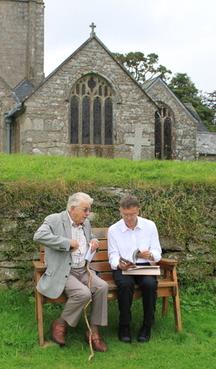
Hands were shaken and we were introduced properly to “Uncle Tom” whose real name it turned out was Tony Beard, retired farmer, broadcaster, historian and past president of the Devonshire association, otherwise known as “The Wag from Widecombe” who, as the local expert, was here to be interviewed for the programme.

John McCarthy and “The Wag from Widecombe”

Tony guided us to the beautiful church yard set at the bottom of the green bowl of fields and moorland all around us. John and he sat on a low bench, Stephen presented the microphone, and the interview began.

Well, I suppose controversy makes for good journalism but I don’t think anyone was expecting it when Tony’s first comment, delivered in his lilting Devonshire accent, was to the effect that, having read Morton’s section on Widecombe, he was of the opinion that Morton had never even visited the place.

This assertion was based on the report of the white thatched cottages which Morton describes as he approached the village in the mid 1920’s after having visited Cornwall. Tony, born in 1936, stated with great certainty there had never been white thatched cottages in the village so Morton’s account couldn’t be authentic.

As I looked around (once I’d picked my jaw up off the floor!) I noted the cottages in view were indeed of dark, ruddy, Dartmoor stone. I also recalled however, several cottages we had passed on the way (and later we were to see many other similar ones) which although not actually in Widecombe itself were close by, and which were of a pale stone or even whitewashed, and thatched to boot. Morton would certainly have driven past such dwellings on the way to Widecombe nearly a century ago, and they may have caught his eye as being typical of the region therefore worth including in his account. Perhaps a combination of a changing village landscape and a touch of artistic license might account for this apparent anomaly, who can say.

The interview progressed well despite this slightly wobbly opening with John, an admirer of both Morton and Dartmoor, managing to keep things light and with Tony imparting many fascinating facts about the village and its legends, people, history and landscape. By way of compensation perhaps for his initial remark Tony conceded happily that he had particularly enjoyed Morton’s description of the charabancs bringing tourists to the village at the time of his visit, something he himself remembered from years gone by. At the conclusion (and after some prompting from the producer) Tony suggested that John should see the prison at Princetown next (in fact they had been there the day before and done interviews at that time, such is the magic of broadcasting!).

In fact we were off now, not to Princetown but to the village of Bow, near Exeter for the highlight of the day (for me anyway) when we were to come face to face with a real live Bullnose Morris…

§

part 2…

The Bullnose Morris:

“He asked me where I was going in that little blue motor-car.”

HV Morton – In Search of England 1927

We arrived just after 11.00am at the house of Nicholas Rhodes, owner of a two seater “sports type” Bullnose, circa 1923. This would have been similar to Morton’s (also a two seater), the most obvious difference being the colour of the body work which in this case was a deep maroon rather than blue as Morton describes his car. Other parts were a mixture of polished brass and gleaming chrome with a varnished plank of pine which served as a dashboard into which instruments were set, screwed or nailed apparently at random.

There was a large clock which wouldn’t have looked out of place on a mantelpiece, which Nicholas assured me was extremely accurate but only twice a day! Next to the clock was an old fashioned brass light switch which in turn was set next to a large brass lever. The driver’s foot-well was stuffed full of more impressive-looking levers and pedals of unfathomable purpose. The eponymous Bullnose shaped radiator was surmounted by a device of brass and clear glass within which was set a tiny indicator needle I was informed was a thermometer, to give the driver an idea of engine temperature.

Finally the moment had arrived and, after John McCarthy had been for a spin and done his interview, it was my turn to play. Without such modern luxuries as doors it was was one foot on the running board and a low hop over the gunwale to get settled into the somewhat small passenger seat. As soon as I had a decent grip on the brass handles inside the car (which seemed to be the nearest anyone got to seatbelts in the 1920’s) we were off into the byways of Devon.

The Bullnose Morris in full flight

The first thing that struck me was the impression of speed as we bowled along at what felt like a considerable rate of knots. Doubtless this feeling was enhanced by the precarious nature of the ride; open topped roof, no seatbelt and a worrying proximity to the solid walls of those notoriously narrow lanes; but actually we did seem to be going at quite a lick for such a tiny and venerable old vehicle. We whizzed along, frightening passers-by with the rich whine of the engine and the rattle of the superstructure, at one point bellowing a hearty good morning to a lady and her Jack Russell terrier as we roared past leaving them pressed into the hedge in our wake. It was all I could do not to shout “Poop poop!”.

As we drove Nicholas told me a little bit about the car which Morton, in his original Daily Express articles had christened “Maud” to lend a little light hearted colour to his accounts. The Morris-Cowley Bullnose was the most popular car of its day, being turned out at a rate of 10,000 per year at peak production in the 1920’s. It toppled the spindly Model-T ford from its premier position by virtue of being simpler to run and to maintain and went on to become the real “people’s car”, a direct precursor to the Minis and Morris Minors of the modern age.

Accordingly it suited Morton’s needs perfectly, lending a popular touch to his accounts as he set out to encourage a love and understanding of the countryside as the road network improved and personal transport developed and became affordable. According to Nicholas the car was also incredibly robust and when I mentioned Morton had taken “Maud” to the Scottish Highlands at a time when the roads in that region were even more wild and untamed than they are now he replied that he wouldn’t hesitate to do the same today. Apparently the Bullnose is “built like a tank” underneath.

Finally, with a roar and a waft of petrol we were back and shooting up the drive into the garage where, despite a frantic flicking of the big brass switch, the Bullnose obstinately continued to rumble and shake, and pour out a rich exhaust. I was told by Nicholas that this “running on” was because the magneto was failing to earth (I nodded politely at this, even though my understanding of things mechanical is approaching zero). It was only when he turned a tap under the dashboard to cut off the fuel supply that the racket finally subsided. Was this, I wondered, a case of “hysterical engine” as reported by Morton?

After politely declining the offer of a cup of tea and promising to send on photographs of the occasion we hopped back into our decidedly more mundane steed of the road and headed North, on the long trek to Clovelly.

Clovelly, the interview and home:

“Somewhere a donkey brays; and you walk slowly up the hill.”

HV Morton – In Search of England 1927

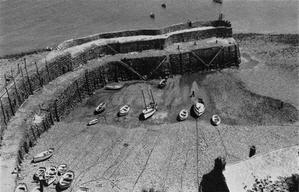
Clovelly harbour at low tide from Morton’s “In Search of England”

Clovelly harbour today – a very well preserved village!

We arrived at Clovelly just before 2.00pm, somewhat later than scheduled. Stephen and John had already descended to the harbour to continue the recording and, after contacting them via the wonders of the mobile phone, we were shown past the reception point and through into this most precipitous of villages. It was the first and almost certainly will be the last time I have ever been able to say “Let me through, I’m with the BBC”!

After a precarious wobble down the steep cobbled street towards the harbour, taking in donkeys en route, we arrived breathless at the bottom, where I prepared to hold forth on the subject of my favourite author. Having now driven around 150 miles in hot Summer weather my old pate was becoming somewhat addled as we walked round the harbour wall to find a spot which was quiet enough to conduct a recorded interview yet still had enough background noise to lend a bit of atmosphere. A small part of me was beginning to question the sanity of my bright idea of following the recording all day as it processed around Devon.

Nevertheless I hope I acquitted myself passably well and managed to convey some of the reasons for my love of Morton’s works and the role of the HV Morton society in trying to promote the man and his writings, as well as talking a little bit about Morton and his Bullnose Morris into the bargain. How much of it will make sense when played back or, in fact, will survive the editor’s scalpel remains to be seen. Responses are always so difficult when one is put on the spot in-front of a microphone; it’s always so easy to think clearly after the event about what it might have been better to have mentioned or indeed, not to have mentioned.

Stephen, who did the interview, was first class however. The questions were straightforward and he managed to put me at ease as the consummate professional he clearly is.

Finally it was the parting of the ways, after a quick chat with the people responsible for marketing Clovelly in the competitive tourist business and a quick photo of John and me against the beautiful (and, yes, still “quaint”) harbour. Everyone shook hands with a feeling the day had gone well and then it was that weary, but oh so picturesque, climb to the top of the village, a quick ice cream from the gift shop and back into the car to begin the journey home to Somerset.
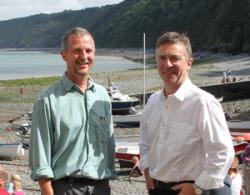
A career highlight – John McCarthy gets to be photographed with the coordinator of the HV Morton Society!

So, all things considered, a great day out which I wouldn’t have missed for all the tea in China. Tiring certainly and occasionally a little nerve racking to one unused to being interviewed and unversed in media techniques but a once in a lifetime experience for me. I now have a greatly increased respect for those professionals who do this sort of thing every day for a living, as well as for those amateurs we see being interviewed on the news from time to time who seem to come across so well; not at all like my tongue-tied ramblings!

The highlight of the day for me was without doubt whizzing precariously through the country lanes in a Bullnose Morris, getting a real, first-hand idea of how Morton might have felt, all those years ago, as he set out on his adventures, leaving his beloved London and going “In Search of England”.

Niall Taylor, Glastonbury, Somerset, UK
17 September 2012

Leave a comment

Filed under Travel

On the switching on of the fountains in Trafalgar Square

“The pigeons, which have become as plump and pampered as the pigeons of St Mark, took panic at this daily event and, exploding upwards from every corner of the square, performed a couple of turns round Nelson before they settled down again to bow on their mulberry-coloured feet to kneeling provincials with bags of peas.”

HV Morton, “In Search of London” (1951)

Leave a comment

July 28, 2009 · 8:40 am