In Search of Australia

This article first appeared as HVM Society Snippets – No.166

On the first of April, 2005, an HVM Society Bulletin from Peter Devenish claimed the discovery of a previously unknown HV Morton title: “In Search of Australia”. Sceptics in the ranks smelt a rat (or would that be a possum?), particularly given the date of this astonishing announcement. When Peter revealed his April fool prank some days later, relief and amusement abounded in equal measure!

Recently however I have come across evidence which shows, incredibly, “In Search of Australia”, written by HV Morton, was at one time discussed as a serious possibility.

For the following article I am deeply indebted to the Australian National Library’s fascinating “Trove” archive, containing over one third of a billion (!) online pieces, including books, journals, newspapers, maps and music. Trove is described on its web site as an “exciting, revolutionary and free search service”. The fact that it is also highly addictive isn’t mentioned, so be warned – I have spent many a pleasurable hour idly browsing though this rich source of material, greatly to the detriment of domestic duties!

With best wishes,
Niall Taylor, Glastonbury, Somerset, England

Courtesy of Wikipedia

Courtesy of Wikipedia

§

HV Morton seems to have been held in some esteem in Australia, so much so that on 5th November 1935 a letter was written by one E. Phillips Danker, Brookman Buildings, Grenfell street, Adelaide, South Australia, to the Adelaide Advertiser as follows:

ADVERTISING AUSTRALIA
INVITATION TO H. V. MORTON PROPOSED: To The Editor

Sir— As a practical scheme for advertising Australia, and incidentally our own State Centenary, I wish to suggest that Mr. H. V. Morton, the well known and entertaining travel- writer be invited to this country for the purpose of compiling a book on Australia. Mr. Morton has ‘discovered’ England, Ireland, Wales, and Scotland (the latter twice), and has worked London to its limits. He has visited Palestine and now, we might presume, is looking for fresh fields to conquer. I think it is therefore very possible that he would accept an invitation for the Discovery of Australia. The publication of a book by such a popular author, while being a sound financial proposition for himself, would arouse interest overseas which would undoubtedly have a beneficial effect upon this country in the matter of potential trade investment, and tourists. For our own part, to see ourselves as others see us is always of value. Although we, in connection with our Centenary, should be the prime movers, invitations should also be extended by the other States. The fact that this book might not be published in time to influence Centenary visitors is unimportant, and is not the main issue

I am, Sir, &c,

This suggestion came at a fortuitous time for not only was South Australia holding its state centenary celebrations in 1936, but celebrations for the 150th Anniversary of the Commonwealth of Australia were due to be held in 1938, the same year as the Empire Games were being hosted in Sydney, New South Wales.

The impression from press clippings at the time suggests a strong feeling that Australia should use this opportunity to allow the wider world to know and appreciate what she had to offer as a country, and invitations were made to foreign film-makers and authors, of which HVM was one, to come to visit Australia in order to help with the development of this idea.

From what I can gather from the Trove archive, E. Phillips Danker’s suggestion was taken up and discussed, until a column in the paper summarised opinions on the 5th of November the same year, thus:

“… Both support and criticism of the suggestion were received yesterday from literary men in Adelaide. Mr. R. Irwin, representing the Friends of the Public library, said that if a man like Morton were to come to Australia and see the country, he would be bound to write about it. He appeared to see the best side of the countries he visited, yet his pictures were true to life. He would be a splendid man to get to South Australia for the Centenary. Mr. W. H. Langham, of the Public Library Board, said that he saw no objection to inviting H. V. Morton to visit Australia, but he did not think that the writer would accept an invitation. Morton appeared to excel in writing about countries with a history and tradition, a tradition in which he himself was steeped. He would hardly risk his reputation in discovering a new country like Australia. ‘We do not want discovering,’ Mr. Langham added. ‘What we want is criticism, such as might be dealt us by a writer like Aldous Huxley.’”

Then, on Monday 20 July 1936, The Sydney Morning Herald (NSW) carried this article on page 11:

150th ANNIVERSARY.
Book by English Author Suggested.

“Mr. A. W. Hall, of Springwood, has written to the Minister in charge of Australia’s 150th anniversary celebrations (Mr. Dunningham) suggesting that Mr. H. V. Morton, writer of “In Search of England” and “In the Steps of the Master,” should be invited to Australia for the 1938 celebrations and provided with every facility to write “In Search of Australia.”

Landmarks 0116

Two days later, a letter with a somewhat more partisan flavour appeared from W. E. Fitzhenry, the Secretary of the Fellowship of Australian Writers who (understandably, given his position) felt if anyone was going to publicise Australia to a wider world, it should be an Australian. The title “In Search of Australia” seems now to have become firmly embedded in the popular imagination:

“… if those who are responsible for the 150th anniversary celebrations do decide to sponsor a work of such nature, there would be no need to go to the expense of importing a writer from overseas. We have in Australia a number of excellent descriptive writers who could be trusted to capture the spirit and beauty of their country equally as well as H. V. Morton has captured the spirit and beauty of his country in “In Search of England.” If we are to have “In Search of Australia,” let it be written by an Australian author. In case Mr. Dunningham is giving serious consideration to Mr. Hall’s suggestion, I recommend that he should weigh the claims of Nina Murdoch, Frank Dalby Davison, J. J. Hardie, Will Lawson, S. Elliott Napier, Archer Russell, William Hatfield, Frank Clune, and Ion Idriess, to mention just a few Australian authors whose names readily occur to me. Lovers of Australian literature will be able to name many others who could present the Australian scene as no stranger to our shores could.”

A week or so later came a response from one H. Macpherson:

“… surely most people will agree that H. V. Morton is the only one who will go in search of Australia, and find it, as surely as he found England, Scotland, Ireland, etc. He will not go in search of notoriety, and Australia and the world of readers will have a truthful account of his search. There is only one H. V. Morton, and Australians will see “themselves as others see them.”

– I am, etc.,”

An anonymous columnist summarised both positions on 1st August 1936 but came down in favour of a foreign author:

“The Australian National Travel Association’s invitation to the famous author of ‘In Search of England‘ is of the same character as the scheme whereby well-known American writers recently came here at the initiative of the association. The primary purpose of such invitations is to secure writers of high standing in their respective countries whose descriptions of Australia will reach a wide public there… For this purpose the merit or knowledge of Australian writers is little to the point, since they have not created a great personal public of British readers. The author of ‘In Search of England‘ has achieved this feat in the most striking way by the outstanding excellence of his various travel books. Certainly no Australian writer, and probably no other English one of the same kind, could command such a wide and attentive audience in the British Isles with a book upon Australia.

“An oversea author can also bring to our country a fresh vision and a new outlook, perhaps discovering beauties of which even we ourselves are not completely aware. For what do they know of Australia who only Australia know? It is quite possible that we ourselves, in such a case, may not always be able to see the wood for the trees… An experienced traveller like Mr. Morton also brings a trained observation and a breadth of view obtained from wanderings in many lands. He can thus avoid the superficial or distorted criticism of the country and people “down under” from which we have sometimes suffered at the hands of some oversea visitors in the past… Thus we hope that Mr. Morton will honour us with a visit, and we can promise him a warm welcome when he arrives ‘in search of Australia.'”

On the 4th of August, this invitation was confirmed, in The Argus (Melbourne, Vic.):

H V. MORTON MAY VISIT AUSTRALIA
Guest of Travel Association

“Mr. H. V. Morton, whose articles “In the Steps of St. Paul” are appearing in ‘The Argus,’ may visit Australia late next year or early in 1938.

“He has been invited by the Australian National Travel Association. The chairman of the association (Mr H. W. Clapp), who is also chairman of the Railways Commissioners, said yesterday that Mr. Morton had been invited to visit Australia as the guest of the association, and he had replied that he hoped to be able to accept the invitation before long.”

Australia uid 1039743

Interested parties didn’t have to wait long, and on 10th August, The Grenfell Record and Lachlan District Advertiser (NSW), announced:

“Mr. H. V. Morton, the well-known travel writer, has accepted the invitation of the Australian National Travel Association to visit Australia early in 1938. “In the Steps of St. Paul” written by this noted writer, is at present appearing in the ‘Record.'”

Enthusiasm grew during the month of August with a column in “Advocate” (Burnie, Tas.) hoping that Tasmania would get a mention in the proposed work and stating, “… somehow I feel there would be much in our ‘Tight Little Isle’ to capture the fancy of H. V. Morton, who sees beauty and that which is very human all around.”.

The Australian Women’s Weekly of 15 August wrote, of Morton:

“His inimitable travel books have a flavor of their own, and as he is a keen observer and writer of infinite gusto the Australian scene should appeal to him… Australia is in need of the right publicity overseas, and visits by men of the calibre of H. V. Morton can do much to present us in a correct light to the rest of the world.”

Then, inexplicably, as far as I can gather from the Trove archive, things go disappointingly silent. It isn’t until nearly four years later, in 1940, that a series of short paragraphs start to appear in various newspapers across the country, of which this, from the Kalgoorlie Miner (WA), on Saturday 3 February, is typical:

Publicity for Australia
AUTHOR’S PROPOSED VISIT Sydney, Feb. 1.

“Mr. H. V. Morton, the well-known British travel writer, will visit Australia after the war to seek material for further works. Mr. Morton has informed the Federal Government that he would have come here at once had the war not occurred. The Minister for the Interior, Senator Foll, said tonight that the Ministry would give Mr. Morton every assistance he might require. Mr. Morton is best known for his ‘In Search of . . .’ series of books…”

So it appears that plans for HVM’s visit “down under” were delayed to the point where war intervened, after which both Britain and Australia had other, more pressing, priorities.

The archive shows that HVM continued to contribute articles to various Australian newspapers throughout the war (“Night watch over England”, “Truth about army cooks”, “They man the beaches and the tanks”) and afterwards (“The Good Old (Pre-Austerity) Days”, “A pineapple problem”). The proposed visit, hailed so enthusiastically in the summer of 1936 and postponed to an unspecified time after the war however, seems never to have materialised; HV Morton never did venture “in search of Australia” – and I think that’s a great pity.

Further reading:
There are three fascinating video clips of Australia’s 150th Anniversary celebrations here.
… and some photographs from South Australia’s State Cenenary here.

4 Comments

Filed under Magazine Articles, Travel

An unusual HVM connection

HVM Society Snippets – No.163
(originally circulated to the HV Morton Society 25 January 2014)

“Jo went leaping down the stairs…”

An unusual HVM connection

Dear Fellow Mortonites,

Some time ago I received an email from someone who described themselves as “a middle-aged Welshwoman living in the English Midlands” who went by the name of Molly. She had spotted the HV Morton website and made contact.

Molly wrote, “I came to Morton initially because I was on a quest to read all the books referenced in  the Chalet School series, where a character is reading ‘In the Steps of St Paul‘. So I read this, loved it, told my 86 year old father, and it turned out that Morton had been a great favourite of his family in the thirties. Further, I found a cache of books on his shelves… I continued with ‘In the Steps of the Master‘, ‘In Search of England‘ (which I found just a little self-conscious at times) and am now thoroughly enjoying ‘In Search of Wales‘.

Chalet School is a series of 60 books set in a girls’ school, written by Elinor Brent-Dyer between 1925 and 1970. According to wikipedia the original school was located in Austria then, following the rise of Naziism, relocated (rather rashly, with hindsight, even for a fictional establishment) to the Channel Islands before moving to the British mainland and then finally back to the continent, this time to Switzerland. Although modern-day reprints are available they are often heavily revised and altered (presumably in the name of “political correctness“) and, as a result, many of the original editions are highly sought after and change hands for considerable sums of money.

Cover

As one would expect these days, these books have an internet presence including the polished and informative “Friends of the Chalet School” and “insanity sandwich” (now no longer updated) which has a web page listing every one of the books & plays mentioned in the Chalet School series – there is an enormous number of them, Molly certainly has her work cut out.

Molly informed me the passage in question was from “The Highland Twins at the Chalet School“. To give a little context, Jo (the ongoing heroine of the CS) has gone off to collect the eponymous highland twins from the station. She is going to look after them because the Admiralty have commandeered their Scottish Island for the duration. (it’s set in 1940).  Robin, who is roughly 17 years of age and ridiculously angelic – she is later to enter a convent – is reading Morton. The excerpt is as follows:

Jo went leaping down the stairs, and Robin, left to herself, glanced at her wristwatch which was lying on the bedside table. ‘Twenty to six. Jo will have to buck up if she means to be at Armiford station by half-past six. Not that I think it will do any good. Well, I’ll just have another chapter or so of “In the Steps of St Paul“, and then I’d better get out. But it’s not worth while going to sleep again.’ She pushed up her pillows, pulled a woolly round her shoulders, for her nightgown was sleeveless, and the morning air coming through the wide-open window was sharp, with just a touch of frost, and settled down to a half-hour of enjoyment.

As to why Brent-Dyer chose to have one of her characters reading “In the Steps of St Paul“, Molly has a theory: “My guess is that she hadn’t actually read it herself, and thought it was more  – shall I say – religious and less political/travel-ly/generally contemporary than it is…“. Seen that way, Morton’s work would be ideal reading material for the “ridiculously angelic” Robin, seeking a literal path to enlightenment by following in the steps of one of Jesus’s disciples.

I hope this has been of some interest to Morton completists such as myself. If anyone enjoys this sort of thing you might be interested in a previous article listing a few more quirky links, including the wonderful “Hackney Podcast“.

With best wishes,

Niall Taylor, Glastonbury, Somerset, England

Leave a comment

Filed under Connections, HV Morton

Thoughts of Glasgow

Bargain finds at Paddy's Market 1970 - (Photo copyright Jim Leggett - International Press Service)

Bargain finds at Paddy’s Market 1970 – (Photo copyright Jim Leggett – International Press Service)

“Glasgow on a November evening…

“The fog which has tickled the throat all evening relents a little and hangs thinly over the city, so that each lamp casts an inverted V of light downward on the pavement. The streets are full of light and life. Pavements are packed to the edge with men and women released from a day’s work, anxious to squeeze a little laughter from the dark as they move against a hazy blur of lit windows…

“There is nothing half-hearted about Glasgow… She is the greatest, closely-knit community in Great Britain… a mighty and inspiring human story. She is Scotland’s anchor to reality.”

From “In Search of Scotland“, chpt 11, section 2, 1929

Thinking of the people of Glasgow and those affected by the tragic events of Friday night.

Niall Taylor 1 December 2013

3 Comments

December 1, 2013 · 11:18 am

HV Morton on London

4503329 small

“So when I ask myself why I love London I realise I appreciate that which is London – a thing very like family tradition for which we in our turn are responsible to posterity – and I realise that I am every day of my life thrilled, puzzled, charmed and amused by that flood tide of common humanity flowing through London as it has surged through every great city in the history of civillisation. Here is every human emotion. Here in this splendid theatre the comedy and the tragedy of the human heart are acted day and night.”

HV Morton, 1926

1 Comment

November 28, 2013 · 10:49 am

The Ultimate Peace Symbol

Originally distributed as HVM Society Snippet – No.159

PoppyDear Fellow Mortonites,

The first flower to regrow in soil disturbed by battle is the red corn poppy. This was initially remarked upon during the Napoleonic wars. Later, following the First World War, these bright little flowers were again the first to be seen as the torn, bare earth of no man’s land slowly began to transform back into pasture which, to this day, still carries the deep scars of combat. In 1921 the poppy was adopted as a symbol to commemorate soldiers who have died in war.

London Year, the - Cenotaph small

The Cenotaph, by AE Horne from Morton’s 1926 “The London Year”

In his 1926 “The London Year”, a mere eight years after the end of the Great War, HV Morton described, in moving tones, the Armistice Day ceremony taking place around the newly erected Cenotaph, and the two minute silence that followed the laying of the wreaths:

Now London is hushed. The roar from Charing Cross dies away. Only the jingle of a horse’s bit breaks the silence of a people frozen in memory. Three white gulls fly over from the Thames, circle above the Cenotaph, and go. In Whitehall you feel the silence and the prayer ; for men and women are praying. It is not right to look. It is too sacred. The old memories well up in the heart, the old aches, the great joys, the misery, the gallantry, the laughter, and the tears.

How long two minutes can be! How much can be remembered! How little can a few years touch those things that go right down into the heart. I would not dare to look into a woman’s mind at this time—those women with medals! I would not care to imagine their thoughts ; but the young men— ah! in two minutes how many voices call to us, how many faces we remember, how many friendships, how many are the splendid loyalties of those “unhappy far-off times….”

Today, Monday 11th November is Remembrance Day, marking the 95th anniversary of the end of the First World War. The wearing of the poppy, or the laying of a wreath, on this day has nothing to do with politics, or with glorification and everything to do with gratitude, honour and respect and the determined hope that by remembering the past with all its horrors, we can perhaps be spared a repetition of it. The poppy is the ultimate peace symbol, pure and simple.

Tyne Cot war cemetery, Belgium

Tyne Cot cemetery, Belgium

Langemark war cemetery, Belgium

Langemark cemetery, Belgium

Niall Taylor, Glastonbury, Somerset, England
11 November 2013

2 Comments

Filed under Armistice day, HV Morton, Quotations

HV Morton on the Kindle: Something which won’t be on my Christmas List!

This piece was originally distributed as HVM Society Snippets – No.128 on 3rd Ocstober 2011

It is 85 years since H.V. Morton made his journeys around England which became immortalised as “In Search of England”.  One of the most evocative passages for me is the point where he visits St Anthony in Roseland in Cornwall.  While staying with some hospitable locals Morton is invited to trudge up a muddy lane in order to experience the contemporary pinnacle of what we would refer to today as “information technology”: a valve radio.  He meditates on the marvels of this modern miracle and shares the amazement of the locals as he listens to the tinkle of coffee cups and the rhythmic thrumming of a dance band in the Savoy Hotel, hundreds of miles away in London.  Morton was clearly at ease with modern technology.

Kindle

So, it was probably not in the spirit of the great man when I felt a small shudder travel up my spine as I read on the Amazon web-site recently that this first of his series of travelogues is now available in a “Kindle” edition.  The Kindle is an electronic reader, a device claiming to be everything a book is and more.  The adverts show us pictures of actors laughing while whipping Kindles out of over-sized bags (“see how small and convenient it is”) and desperately trying to appear as if they are enjoying themselves while their Kindle is exposed to sand on the beach or being enthusiastically licked by the pet dog (“see how rugged and portable it is”).  With thousands of different volumes stored on a single device you need never worry about having to find a real book on a real shelf ever again – everything is downloadable on a whim.

Well, I’m afraid I am unable to share the enthusiasm of its promoters, hard as this will be for Amazon to bear, I’m sure.  It’s just that I love actual books too much; even the most battered volume in my collection means more to me than the blank, empty eye of an electronic reader ever could. The feel, look, sound and even smell of pages as they are turned beneath one’s fingers is a million miles away from the cold caress of a plastic screen while little computer sounds attempt to mimic the noise of real pages. My books are friends to me, good and convivial companions through life’s journey.  I know each one of them intimately, they represent a living connection with things past and present – people and places I have known and visited down the years (I just have to look at my copy of “In Scotland Again” to be taken back in my mind’s eye to a cottage on the Mull of Kintyre on the shores of Loch Caolisport).

To me reading a book isn’t just about reading words, it is a personal and sensual experience.  Each book, with its individual creases and imperfections, its fonts and layout has a patina, a character of its own that no electronic device could ever capture, no matter how ‘convenient’ it claims to be (although who ever complained that a book’s batteries have run down!).  Some may see me being a “stick in the mud” (as my mother would say) by not moving with the times and keeping up with the latest technology, but that’s not entirely true.  I love the computer age, I am fascinated with word processors, the internet, email and MP3 players.  But books are different, they are my technological line in the sand, “thus far and no further!” I say, and the electronic reader is, for me, a step too far!

Anyone wishing to know more about the Kindle edition of In Search of England should follow this link.

With best wishes,
Niall Taylor, Glastonbury, Somerset, England

p.s. Peter Devenish of the HV Morton Society comments: “Morton certainly was interested in new technology, even in his later years. In his letters he described how delighted he was when TV came to South Africa; and he was as excited as a 15-year-old with the first landing on the Moon. Whether the Kindle would have been the “technological line in the sand” for HVM I don’t know but, with his great love for his library and books generally, I suspect he would have shared Niall’s view.”

3 Comments

Filed under HV Morton

A few Morton Connections

I had just sat down to enjoy a delicious “Pizzetta” from the Glastonbury market, accompanied by a pickled gherkin and a handful of Greek olives, all washed down with a glass of Coolwater Bay Sauvignon Blanc when an excited squeak from the other-half announced that she had stumbled across another HV Morton-related link while surfing the information superhighway.

I say “excited squeak” – it was more of an “oh no, not again“-type expostulation to be quite frank. I’m afraid the dearly-belovéd doesn’t entirely share her patriarch’s passion for all things Morton – a failing of which I am happily tolerant; it takes all sorts to make a world after all and it behooves a good Mortonite to be forgiving of another’s shortcomings.

In Search of England 1952 edn

As it happens I already had in mind a post to air a few of the various connections I have come across recently concerning Morton, the vast number of which are a testament to his phenomenal popularity during the early and mid-20th century. An author, born some 120 years, ago who still regularly crops up on random internet searches has clearly had a tremendous impact on popular culture at some point.

What Alison had discovered was a brief but very significant reference to Morton’s “In Search of England”, the 1927 publication that arguably ushered in the period of his greatest popularity. The link is on a blog, entitled “Socks for the Boys!” by historian and author Alison Twells, featuring a series of excerpts from the diaries of the writer’s Aunt Norah who lived from 1925 to 2009.

The material on the blog gives a fascinating insight into the concerns, fears and everyday events of Norah’s life. Particularly interesting for me was the entry on the page with the heading “Hitler Trouble“, written when Norah was just 14 years old (by my calculation), which begins “31st August 1939: Ma & I went down for tea to Helen’s. Came back early. Went down to Hills & post. Started to read ‘In Search of England’ by HV Morton. Cold. Hitler trouble.

If you have an eye for detail you will not be surprised to realise that what comes next is not this young girl’s impressions of Morton’s travelogue; her reading is interrupted in no uncertain manner by the outbreak of the Second World War, as Hitler invades Poland, and Britain declares war on Germany over the course of the next three days. The day after war is declared Norah’s diary records the sinking of the passenger ship Athenia and ends simply with the comment “sunny“.

Alison Twells’s intention is to eventually publish a book based on her aunt’s diaries and I wish her the best of luck. If her blog is anything to go by this will be a worthy and enlightening project.

§

HV Morton's London

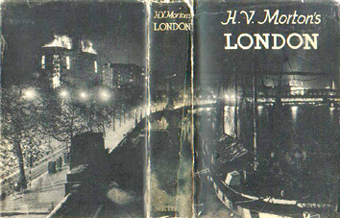
I have no idea what the connection Morton has with hosiery but, after “Socks for the Boys!“, the second website on my list is called “Sockless musings from London“. The blog entry announces a “One a day audio challenge” and goes on to review “HV Morton’s London“, a compilation of his three earlier books “The Heart of London“, “The Spell of London“, and “The Nights of London“.

The reviewer, a Canadian writer who goes by the name of “Sockless“, obviously likes the book quite a bit judging by her comments, and reports it is her intention to share this out-of-print work by posting a section from it online every day for a year.

Sadly however, this is the only post on the blog, her project remains unrealised, and my comment about it remains unanswered. This is a great pity – if you are still out there Sockless I hope everything is OK and that you might return to your challenge at some point in the future.

§

4862506

The final entry today (I think I’ve gone on quite long enough, don’t you!) is a bit of an oddity that I have sat on for some years. It is part of the Hackney Podcast, a series of recordings about the East End London Borough of Hackney. Hackney Podcast volume 18 is a wonderfully atmospheric soundscape, based around readings from “HV Morton’s London” interspersed with selections of street sounds and general goings-on over a 24 hour period, including disoriented clubbers, partying squatters, late night booksellers and market traders opening up for the day. There are also other historical and contextual readings about the area.

Whoever thought of doing this must have quite a vision – the works of HV Morton and the hustle of the modern-day east end wouldn’t necessarily be the most obvious things to put alongside one another but the melange really works and provides a real insight into what it must have been like for Morton as a young  journalist wandering the streets looking for people to talk to and places to see, to use as material for his newspaper column.

After listening to the full 30 minutes of this haunting work,  you are left with the impression that actually, despite superficial differences, Morton himself might well have recognised many of the kinds of people featured in the production and would have discovered much useful material for “HV Morton’s 21st Century London“!

With best wishes,

Niall Taylor, Glastonbury, Somerset, England

8 Comments

Filed under Book reviews, HV Morton, Websites

In Praise of Simple Fare

“How, I wonder, have I refrained so long from praising bread, cheese and beer, the most delicious, satisfying food that can pass the parched gullet of a wayfarer! Fat men in saloon cars can nose the French menus for Sole Colbert or Bordelaise, and for the many dishonest hashes devised by otherwise honest English cooks, but when I am hungry and the white road lies behind me mile on mile, give me bread, cheese and beer.”

HV Morton, “In Search of England” (1927), chapter 7, section 3

2 Comments

September 28, 2013 · 9:52 am

Birds of the Gauntlet

This article originally distributed as HVM Society Collectors’ Notes – No.24

The Cover of "Birds of the Gauntlet"

The Cover of “Birds of the Gauntlet”

Dear Fellow Mortonites,

Just occasionally I like to allow myself the luxury of believing that I might have discovered a previously unknown piece of Mortoniana which will surprise and delight our resident Morton scholars and the rest of the HVM Society. Of course I appreciate that many in the society have been researching Morton for decades and have gone to the considerable trouble of tracking down personal papers, making contact with Morton’s family and acquaintances; acquiring rare publications; travelling to places he visited or lived; and spending hours in libraries, poring over microfiche machines and peering at ageing news-print.

This all strikes me as terribly inconvenient, not to say tedious. After all, this is the X-factor age and the current ethos is quite clearly that fame and success is everyone’s “right” and that if one can only “put one’s heart and soul” into something or “really believe in oneself”, then success will follow automatically and instantly, without the need for all that tiresome self-discipline, hard work and research.

Accordingly, it was after “putting my heart and soul” into many exhausting minutes of googling that I came across the item which is the subject of this bulletin and which I have not managed to find any existing reference to, in connection with HV Morton. Surely this has to be my X-factor fifteen minutes of fame.

In the past, when I have excitedly announced such “discoveries”, those more learned folk who really know their onions, after letting me down gently, announce that they have known all about my latest revelation forever and in fact the item in question is so numerous they have drawers full of them and put them to use propping up wobbly coffee tables and the like, while they study more deserving tomes!

But hope springs eternal, so here goes with my latest attempt at achieving immortality in the Mortonian Hall of Fame.

§

IMG_2595 crop small enhanced

Bakeia

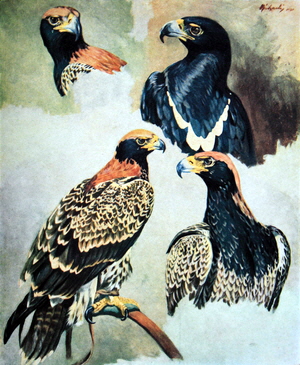
“Birds of the Gauntlet”, written by Heinrich HJ von Michaëlis (another HVM!), was published in 1952 by Hutchinson & Co. ltd. Measuring approximately 11 by 8 inches, it is a hardback, bound in red board with gold embossed lettering to the spine and with a dustcover (above). It runs to 223 pages and is divided into part one; with twelve chapters, and part two; with four. There are eight colour plates and numerous monochrome sketches and studies, all done by the author. The foreword was written by the Marquess of Willingdon, and the introduction by Michaëlis’s fellow Somerset West resident and friend, Henry Vollam Morton. Morton’s introduction can be read in full here: Birds of the Gauntlet introduction.

IMG_2594 crop small

For the uninitiated, “birds of the gauntlet” are birds used for hunting, in falconry. The author describes with great affection the habits and lives of these birds, many of which he has rescued and reared and all of which he admires greatly: “their beauty and spirit appeal to me: many of them have been my friends and good companions”.

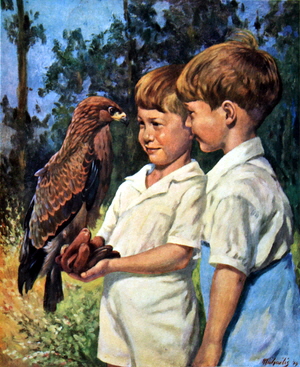
A large part of the book is given over to the stories of individual birds he has adopted, while the later sections are devoted to scientific considerations of flight – relating birds to his other passion, gliders – and of the forms and function of his “good companions”. The whole thing is written with a tone of wonderment and awe that brilliantly conveys his deep feelings for his subjects. The plates and drawings (some of which are included here) are superb and they alone would have made the purchase of this volume worthwhile, even without the Morton connection.

IMG_2593 crop small enhanced

Florian

Von Michaëlis was an artist, sculptor, ornithologist, pilot and expert in gliding. Born in 1912 in Germany to a German father and South African mother, he returned to his mother’s native country in 1937. He died in 1990. His life story – as described in brief by Morton in his introduction – is a fascinating one, encompassing Europe and Germany in particular as the old Imperium gave way to the Reich during the period between the wars. These 1,700 or so words are probably the nearest Morton ever got to writing “In Search of Germany”!

Morton compares Von Michaëlis favourably to some of his charges, describing him as “thin, spare and quick, with a restless darting manner, a rapid and fluent talker and a man who carries forty years with the air of youth”. The introduction has the mature, confident air of Morton’s later works while still retaining that characteristic whimsy and humour. From its tone HVM clearly has a great deal of respect for HvM.

IMG_2596 crop small enhanced

Von Michaëlis’s twin boys with Tonka

It remains to be seen if my discovery will rock the world of Morton scholarship (I ain’t holding my breath!) but whether or not it does, I am delighted to have come across this lovely volume and be able to add it to my little collection.

With best wishes,

Niall Taylor, Glastonbury, Somerset, England
23 September 2013

Leave a comment

Filed under Book reviews, HV Morton, Introductions

Illustrated Magazine’s “Coronation Record Number”

Illustrated Coronation issue

There have been 38 coronations in England since William the Conqueror of Normandy was first crowned at Westminster on Christmas day, 1066. Today marks the 60th anniversary of the coronation of Queen Elizabeth the Second in 1953 following the sadly premature death of her father, King George VI.

On 13th June, 1953, Illustrated Magazine produced a special souvenir edition for the Coronation (a “Coronation Record Number”) to provide, in the words of the editorial, “a full pictorial record of the epic day on which the Queen dedicated herself to the service of God and of her peoples” in the hope that it would “perpetuate for you and your children the memory of June 2, 1953”.

This special edition featured contributions from authors including Sir Compton Mackenzie – “Words from the Heart” – and HV Morton – “A Queen’s Glory Outshines All” – the text of which was transcribed by Kenneth Fields on 2nd June 2011 and can be read in full here: http://www.hvmorton.co.uk/hvmsoc/LN99-101.html#LN100.

Morton’s article begins:

“My seat in Westminster Abbey gave me a perfect view of the objects I wished to see: the Coronation Chair, the Throne, the Chair of Estate and the Royal Box behind it. Nothing else mattered. It was upon that floodlit space before the High Altar, covered with a golden carpet, that the Queen would be anointed and crowned.”

IMG_2781 crop smallWith hints of the central portion of “In Search of London” from two years earlier, and its detailed description of the history and origins of Westminster Abbey, Morton takes us in a broad sweep from the Plantagenets, through St. Edward the Confessor and Henry III, to the present day. With his love of the linguistic, he points out that the ancient word for “Coronation” was the “hallowing, or the making holy, of the monarch”. As the piece continues, he harks back to the Coronation of this new Queen’s father, on 12 May 1937 which he also witnessed, and reported on for the Daily Herald.

The Coronation is, at heart, a communion service and Morton acknowledges this in the closing paragraph of his carefully crafted article as he notes simply:

“Kneeling side by side, the Queen and the Duke of Edinburgh took Holy Communion. Then, to a great pealing of bells and the sound of cheering, with the music playing and the trumpets blowing, Queen Elizabeth II went out from her hallowing, the Crown upon her head and the sceptres in her hands.”

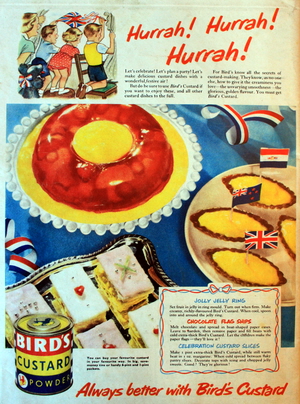
Measuring 13.5 by 10 inches, the magazine is an evocative time capsule, capturing the feelings and aspirations of the time, both in the reverential tone of the articles and in the multitude of advertisements it features. Everything from rainwear, Ovaltine, bicycles and Bird’s Custard is promoted with a respctful Coronation theme.

IMG_2774 crop small

There is even a small advert for “Cuxsome, Gerrard & Co. ltd, Carnation Corn Pads” – for people suffering after standing for hours in the crowds perhaps – and for “glorious” Agfacolour film – just incase anyone was less than satisfied with mere black and white for this special occasion. My favourite is this full colour cartoon from the brewers of Double Diamond beer. Their well known slogan “A Double Diamond works wonders” is wonderfully borne out as a patriotic gentleman is elevated above the cheering crowds atop a teetering tower of beer bottles.

IMG_2777 crop small

Other slogans in this edition have fared less well with the vagiaries of time and an evolving language. One wonders just when it dawned on Mars, the manufacturers of Spangles boiled sweets, that the, then innocent and charming, phrase “Spangles, the sweet way to go gay” had finally run its course and become a less than effective means of enticing children to part with precious pocket-money!

The editorial, with justifiable pride, makes considerable mention of the many photographers who contributed to this important edition. The highlight however, (apart from possibly the cover photograph) surely has to be this central photograph, the first one ever published of the coronation in colour, taken by James Jarche who also contributed many photographs to Morton’s books and articles over the years.

IMG_2768 crop small

This sought-after and delightful magazine is well worth keeping a look out for. It is occasionally seen on the web pages of second-hand book sellers for reasonable cost and would make an important addition to anyone’s collection of Mortoniana.

A BBC article on the anniversary of the Coronation can be read here: http://www.bbc.co.uk/news/uk-22729342 and a selection of photographs of the day taken by the Magnum Photos agency can be seen here: http://www.bbc.co.uk/news/in-pictures-22709637 (they feature Humphrey Bogart and Lauren Bacall who crossed the pond for the occasion and some appalling weather).

With best wishes,

Niall Taylor, Glastonbury, Somerset, England
2 June 2013

Leave a comment

Filed under HV Morton, Magazine Articles, Quotations