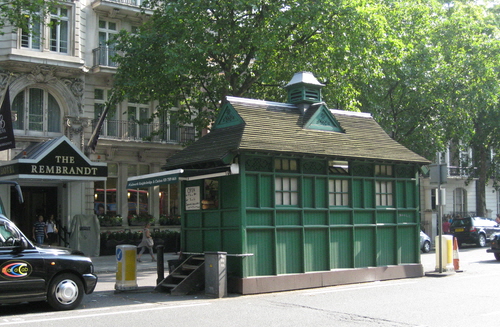
Camera Obscura Still in Use in 1939!

I saw Two Englands small

HVM Society member Stan White hails from Ontario, Canada. Stan is a published poet and a well known professional photographer, specialising in stereo photography; he has written past bulletins on the subject of HV Morton’s keen interest in photography.

So, recently, when Stan sent me the following email, on a closely related subject, it caught my eye and, after a bit of transcription and (strictly amateur) photo-manipulation, I have put it together in a suitable form for sharing with the rest of the Society.

HV Morton made many contributions to the war effort on the Home Front during the Second World War – as well as serving in the Home Guard, he covered stories of the blitz in his columns at the time and wrote his only work of fiction, “I James Blunt” (1942), for no financial reward, as a warning to the nation about complacency in the face of the Nazi threat; earning the personal thanks of Prime Minister Winston Churchill as a result.

Other war-related works from Morton included “Atlantic Meeting” (1943), “Travel in Wartime” (1940) and – the subject of Stan’s article – “I Saw Two Englands” (1942).

— § —

Good morning Niall,

As you know, I am a retired photographer. This year is the 40th anniversary of Photographic Historical Society of Canada and I have a great stack of its magazine Photographic Canadiana, for which, over the years I have written articles on the history of photography and, in fact, still do.

For a while I did a column for it called oddities. My objective was to find tidbits of information relating to the history of photography. Lo and behold, when I was looking through the mags recently I came across this item that I had written back in 1995, long before I had an interest in HVM and which I had completely forgotten about.

Take care,

Stan

from Photographic Canadiana 21-1 May – June 1995

Camera Obscura - Stan White - pic 2

When this column first appeared reporting interesting tid-bits of photographica from non-photographic books, it was expected that there might be the occasional item but so far, we have had three items in almost as many months.

The following is gleaned from “I Saw Two Englands” by HV Morton, published in 1943 by Methuen & Co. ltd., London, and Reginald Saunders, Toronto.

Morton toured England in early and late 1939. On his second tour, shortly after the beginning of the war he gave an account of a visit to the Royal Air Force Flying Training School. The following is an account of a method of training bomb-aimers:

“Another ingenious invention is the camera obscura hut, which tells the instructor whether a man in a bomber several thousand feet above him, has, in theory, bombed the hut. The place is dark save for a circle of light reflected (projected) upon a table through a lens in the roof. A spot in the centre on the table represents the hut.

When an aeroplane is flying overhead you can watch its shadow (image) slowly cross the table, as it is reflected (projected) by the lens. As it nears the centre a tiny white flash is seen, which is really the firing of a magnesium bulb in the aeroplane. This represents the bomb, or rather the exact moment at which the bomber pressed the bomb-release.

“The instant the flash is seen, it is plotted on the table. It is a simple matter to allow for the time taken for the bomb to drop according to the height of the plane, the angle at which it falls, according to the speed and wind, and this shows you how near, or how far, the bomber was from his target.

(words in brackets are mine – SW)

This article was originally distributes as HVM Society Snippets – No.165;
29 March 2014

1 Comment

Filed under Magazine Articles, Quotations

“Vignettes of Childhood and other poems” – a review

There is a slight departure from the subject of HV Morton in today’s post but one which, I hope you will agree, is very much in the spirit of the great man.

Vignetes of Childhood

HV Morton Society member, Michael Thurstan Bassett is a man of many talents – poet, musician and artist. We have all enjoyed his work in the past as he has contributed several of his poems as society bulletins over the years, including this one, now available on the blog. So, you can imagine my delight when I heard he has just had a series of his poems published by Harvest Road Books of New Zealand, under the title “Vignettes of Childhood and other poems”.

When my copy arrived I was keen to see how his other works would compare with those I had already seen, and I wasn’t disappointed!

The anthology is in five sections with the first, Vignettes of Childhood, being a narrative of autobiographical accounts beginning with a small boy’s fascination with war and combat, irresistible when brought to his very doorstep during a childhood spent during World War II on the Isle of Wight. Mike was an eye-witness to the Battle of Britain and the later massing of the fleet prior to the D-day landings and these historical events are captured with evocative immediacy in Mike’s carefully chosen words. Then, from the immediate post-war years there are accounts of a period spent in post-war Germany with all the destruction and horrors witnessed there, before a blissful celebration of homecoming in Vignettes of Childhood V and the final, unfinished, leaving of the homeland for foreign shores. This section is a moving anthem to England and to times past. The final installment is set more than half a century after the first, as the author looks back, contemplating those “precious days”, yet ending with an optimistic note – although we seem forever destined to seek the unattainable, we will encounter beauty and grandeur on the way.

REMBRANDT modifiedMike is also a talented artist – dare one hope the second edition
of “Vignettes of Childhood…” might feature
some of his
artwork, such as this one; an homage to Rembrandt.

Later sections, more philosophical in nature, deal with a number of elemental subjects – gods, dreams, love, homecomings and departures but most of all with the spirit of man which can, perhaps, be seen as the overarching theme of this volume. Mike’s style has a deceptive simplicity, making it very accessible (a bit like HVM!), but like all good writers, contained within it are hidden depths, to be found if the reader cares to look.

Several gems are particularly memorable. There is the touching symmetry of The Lesson of Life (which quite brought a tear to my eye!), the uplifting optimism, despite all that life throws at us, of Credo, and the hopefulness of Orphic Mysteries. We are treated to a little of Mike’s subtle wit with the gently provocative Lunar Landing, as he has a dig at the demystifying of the world around us in the name of progress, and Martha and Mary – a treatise on two of the most iconic women in the Bible, which has much to say about the world today.

Many of the verses in this excellent collection display a wistful longing which is dealt with most movingly – a yearning for home, and for a bygone age – but throughout this is tempered by a more upbeat, positive tone, as in this quote, from the poem, Life’s Tarnished Cup:

For the healthy need no doctors,
And the happy need no priests:
Give man but power and freedom –
What need of sacred Feasts?

All in all this is a highly recommended volume, just the sort of thing to relax with and contemplate, feet up infront of a blazing fire, glass of robust single malt in hand! And I’m looking forward to doing just that this Winter, as I read, once again, this trove of literary treasure from a modest man of great talent.

Niall Taylor, Glastonbury, Somerset, England

2 Comments

Filed under Book reviews

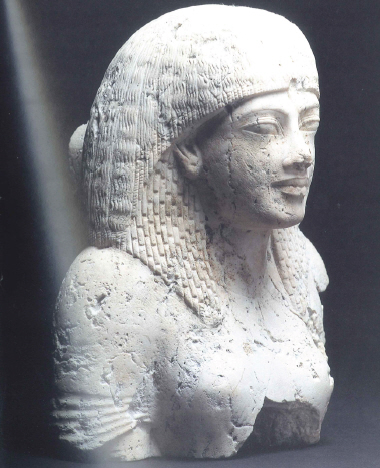
The ‘Monna Lisa’ of Ancient Egypt

Pasted graphic

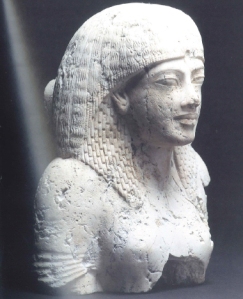
Recently, HV Morton Society member Tony Brett mentioned he had been researching into a small statue at the Birmingham Museum and Art Gallery. The full account of his search makes a gripping tale and Tony’s detective work would rival Hercules Poirot himself!

The story begins almost exactly a century ago…

On page sixteen of his excellent biography “In Search of HV Morton”, author Michael Bartholmew tells us about HVM’s eagerness to go on an assignment for the Daily Express, to report on the opening of the tomb of Tutankhamun, in 1923. The origins of this eagerness are, says Bartholomew, “… traceable to the Birmingham art gallery, where he was intrigued by a little statue”.

He quotes from Morton’s memoirs where Morton reports “My interest settled, for a reason I can offer no explanation, upon an ancient Egyptian bust about half the size of life which I took to be – indeed it may have been so labelled – a priestess of Isis… The work obsessed me and I began writing about it, trying to describe it, and in a moment of recklessness I posted one of these to… The Connoisseur… they printed the article and sent me a cheque for thirty shillings or two guineas. And then, of course, my fate had been cast. To realise while still at school that you can make money while writing is a most dangerous thing.

Incredibly, it is this very statue that Tony has tracked down and, what is more, he has also managed to locate the article which Morton wrote for The Connoisseur magazine.

When Tony began his enquiries by contacting Birmingham Museum and Art Gallery, he was informed by Adam Jaffer (Curator of World Cultures) that the statue itself was most likely a piece known as the Limestone New Kingdom Bust donated to the museum in 1896. Adam told Tony two articles had been written about the bust, both in 1914.

The dates of the articles came as somewhat of a surprise to Tony, given Morton, born in 1892, had suggested in his memoirs he was at school when his was published. If one of these articles was actually Morton’s, this would make him a very late developer – still at school at the age of twenty two!

Undaunted, Tony set to work tracking down the relevant editions of The Connoisseur magazine. The Birmingham Library had, unfortunately, mislaid their copies in a recent move but they put him onto Birmingham University who in turn referred him to the Barber Institute who, at last, came up with the goods.
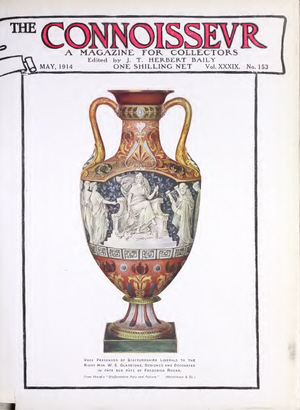
Connoisseur cover 2

Tony got browsing and, sure enough, to his great relief, in the May 1914 edition he came across an article entitled “The ‘Monna Lisa’ of Ancient Egypt”, featuring a picture of the Limestone New Kingdom Bust – without question this was the article referred to in Morton’s memoirs!

Incedentally, by virtue of a little detective work of my own, I have discovered that the May 1914 edition of The Connoisseur is available online courtesy of the Internet Archive, here (Morton’s article is on page 27 of the pdf).

But what about the apparent discrepancy regarding Morton’s age when he wrote the article – just how long was HVM at school? Well, Morton’s memoirs were written towards the end of his life, while living in South Africa, and it is likely advancing years and possibly a little harmless artistic license accounted for this minor inaccuracy. It bears mentioning that the statue which, in his memoirs, is referred to as “a priestess of Isis”; was assumed by the younger Morton, in the original article, to be a representation of the goddess Isis herself.

The article is fascinating for a number of reasons in addition to being the original work which helped determine Morton’s future career. For one thing, it is certainly the earliest published work of HV Morton I have ever come across, but the Morton we know and love is there to be seen in his writing style, particularly his evocative and lavish descriptions.

The title of the article too, is interesting – the “Monna Lisa” of ancient Egypt. This isn’t a mistake; Morton is using the authentic Italian spelling of the title of Da Vinci’s work, to which he is comparing his ancient carving.

The thing that threw me completely for a while though was at the end of the article – the initials HCM. Had Tony fallen at the final hurdle I wondered; is this article even by Morton at all?

It is possibly because I am a veterinary surgeon that my confusion lasted as long as it did – the acronym HCM describes a particularly nasty heart condition suffered by cats! So I hope I can be excused for not realising at once that, although this wasn’t our familiar “HVM” (Henry Vollam Morton), it was the much less frequently (if ever) seen “HCM”, or Henry Canova Morton.

In an article by HV Morton’s niece, Jo Walters, she informs us Morton family legend holds that while Maggie, HVM’s mother, was expecting her first child in 1892, she bought some heather from a gypsy-woman. As she was leaving, the woman turned and said; “The child you carry is a boy, and if you call him ‘Canova’ he will be famous in one of the arts”.

Apparently HVM didn’t share his mother’s enthusiasm for the name Canova, (it came from a Venetian sculptor) and always said he did his best to keep it secret. But on this one occasion he has used it, albeit just the initial, and I don’t think anyone could deny that it did indeed help him on his way to becoming “famous in one of the arts”. Perhaps the prophecy of the gypsy lady was correct! Young Harry clearly wasn’t convinced however as, having this once appeased the fates, he thereafter dropped the “Canova” moniker in all future writings.

There is one, last point of interest about the article, not at all obvious from reading it, but which Tony has also uncovered in his researches. It turns out, the “Monna Lisa” of Ancient Egypt isn’t all she appears to be – that “weird smile”, which so entranced our young author, keeps a secret; one which, even to the end of his days, Morton remained blissfully unaware of. Read on to Part Two (below), where the secret is revealed!

§

“The ‘Monna Lisa’ of Ancient Egypt” part two… a Twist in the Tale
In which we discover that HV Morton has been labouring under a slight misapprehension!
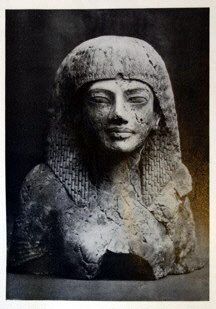
DSC01464_2 crop

Tony Brett first came across a possible reference to the statue, referred to by HVM as “The ‘Monna Lisa’ of Ancient Egypt“, when he wrote to Adam Jaffer for advice. Adam is Curator of World Cultures at Birmingham Museum and Art Gallery (BMAG) and clearly knows his onions because he recognised the statue from the brief description in Morton’s memoirs as being a piece known as the Limestone New Kingdom bust and so put Tony on the trail.

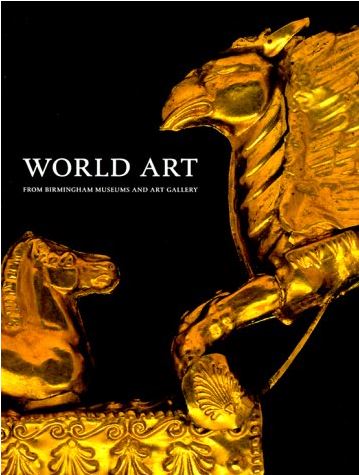
As a bit of background Adam kindly provided an article (sections of which can be seen below) written by Philip Watson – then principal curator in the Department of Human History – for “World Art”, a Birmingham Museum book published in 1999 and edited by Martin Ellis; a show-case for what BMAG considered their best pieces. This article proved most revealing:

§
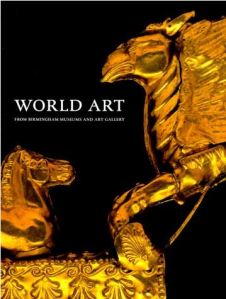
World Art cover

EGYPT, NEW KINGDOM, LATE 18TH DYNASTY, 1400-1300 BC

Limestone Height 30cm (11 3/4 in.) Presented by Miss Hanson, 1896 (1896 A 69)

Despite being broken and unkindly treated by the ravages of time, this head is the finest piece of sculpture in Birmingham’s Egyptian collection. It is carved out of a hard limestone that unfortunately contained patches of softer rock, which have weathered away to produce the current pitted appearance. The piece was highly, polished and originally would doubtless have been painted, as was customary for Egyptian sculpture.

It was presented to the museum in 1896 and two accounts of the bust (both published in 1914) extol its charm and beauty. One of them calls it the “Mona Lisa of ancient Egypt” and interprets it as a bust of the goddess Isis. The unknown author is “astonished by her beauty“, comments on her “weird smile” and finally asserts that “all the beauty, all the mystery and all the culture of dynastic Thebes blossom on the lips of this strange, stone woman“…

Despite such eulogies, the head is, in fact, that of a man. The rather feminized breast is typical of Egyptian sculpture from the reign of Amenophis III, and the gracious, rather soft physiognomy recalls later eighteenth-dynasty statuary. The figure also wears a distinctly, male duplex wig; the top and back of the wig have wavy strands of hair tied into ringlets at the ends, and these seem to be superimposed over a second wig composed entirely of ringlets, which drop forward over the shoulders. This style is common in the late eighteenth dynasty… [PW]

§

So, wonderful detail about the statue and clear links to Morton’s Connoisseur magazine article, but unfortunately for HVM, and in spite of his reputaion as someone with an eye for the ladies, it turns out his “Monna Lisa” is a bloke!

In fairness, even looking again in the light of this information, the statue’s masculinity is far from obvious and, according to Watson, our man (the “unknown author” of the first 1914 article mentioned above) wasn’t the only one to have made the mistake.

In his memoirs, Morton was still referring to the statue as “she”, suggesting he probably went to his grave without realising his faux pas; but for us this footnote is an another entertaining facet of the life and works of Henry Canova Vollam Morton.

World Art” is for sale in the Birmingham Museum shop and, although the Limestone New Kingdom Bust is currently “off display” (as the Egypt Gallery is closed due to building work for the new Staffordshire Hoard Gallery)*, it will be back on view once again in May, for all to enjoy.

I would like to express my thanks to Tony, on behalf of the HV Morton Society, for the tremendous job he has done in unearthing this early treasure to add to our archives.

Niall Taylor

*This item was originally circulated as HV Morton Literary Notes – No.123 parts 1 and 2, in March 2014

6 Comments

Filed under Connections, HV Morton, Magazine Articles

Judging a book by its cover

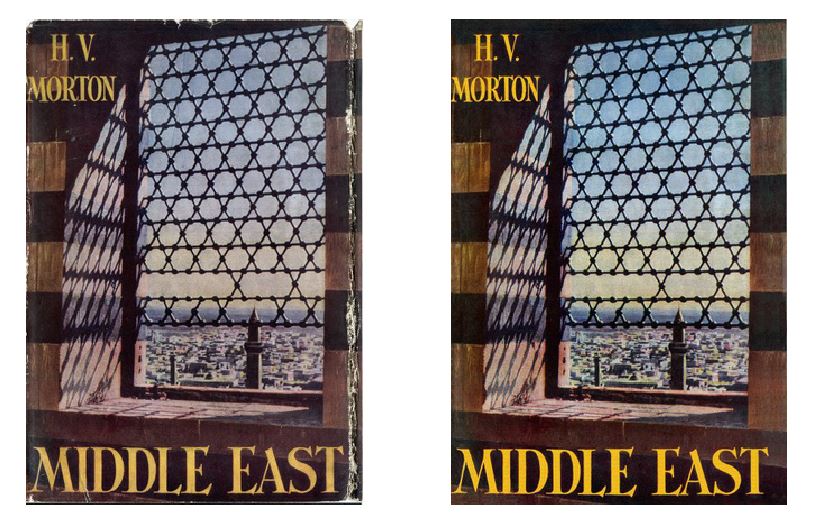
Middle EastMiddle East” – a challenging example of photogravure
(or so I am reliably informed!), before and after restoration.

Over a year ago, during one of my HV Morton internet trawls I stumbled across a website called “Reprojackets” which immediately grabbed my attention, as I was whisked, courtesy of google, to their HV Morton section.

I discovered the website offered high quality reproductions of classic book jackets. At the time, in the gallery, there were two HV Morton jackets – C W Bacon’s 1964 “A Traveller in Italy” and Fred E Taylor’s jacket for the eariest editions of “In Search of England” – both of which amazed me. I have always loved much of the artwork associated with HVM’s publications, and the idea of having them restored and refreshed to their original vibrancy quite took my breath away (you can tell I don’t get out much!).

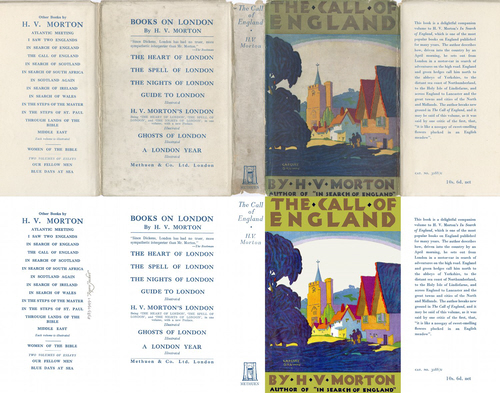
1949 Morton CallEngland smallGregory Brown’s “railway-poster”-style cover to “The Call of England
– now restored to its original vibrancy.

I decided I would like to have one for myself and, after prizing up the loose floorboard under my bed, I was in the process of dusting off my wallet and wondering whether groats were still legal tender when, to my surprise, I received an email from John Whythe, the proprietor of the Reprojackets website himself!

John, it turns out, is a very pleasant and learnéd man who hails from Abergavenny, in Wales. The reason he had got in touch was regarding his recent purchase of a very early copy of “In Search of England” which he suspected was something special. I was able to help by putting him in touch with Peter Devenish and Kenneth Fields and it was quickly confirmed that John had in fact bagged that holy of holies, a first edition “In Search of England”. After that, our correspondence continued and, on realising my interest in his project, John enlisted me as a willing recruit, to help by scanning some HVM jackets for him. This was a bit of an experiment as up to that point he had done all the scanning himself, from his own copies.

iSoEBefore and after – Brian Cook’s 1939 cover to “In Search of England
– radiant colours once again

Since then I have sent John a steady trickle of scanned jackets – enormous, highly detailed 600dpi TIFF pictures – and have watched in amazement as he has restored them to the condition they were in when new, whole layers of colour and detail, previously obscured, are revealed – and his gallery has expanded.

John has an real eye for detail as he painstakingly strips the digital image of each jacket down to its component shapes and colours and then carefully builds them back up again anew after patching and repairing any defects caused by the passing of years. The final touch is to add a Reprojackets identifier logo – unobtrusive but unmissable – to ensure there is no confusion between copy and original. John has been kind enough to send me a couple of examples of his finished work; they are quite exquisite and I intend to frame them.

1941-4 Morton London smallAF Kersting’s atmospheric waterscape from the cover of the 1946 edition of “HV Morton’s London

You can see the process in action as John has presented a restoration sequence on his website here, and an animation here.

John is also very knowledgeable in all things bibliographic and has educated me on such things as the difference between a “printing” and an “edition” and also on various types of fonts – it was he who supplied the information about the unusual ligatures in the Caslon font employed in some of HVM’s early works (see HVM Literary Notes – No.124).

1928 Morton Land Vikings 1560 smallOne of my favourites – the highly collectible cover to “Land of the Vikings

So, if you have a spare moment, I would urge you to hop along and have a look at John Whythe’s meticulous and sympathetic restorations of, not just Morton’s works, but those of other authors too, from Hugh Lofting to PG Wodehouse and Arthur Ransome to JRR Tolkien.

The artwork for me is a significant part of the “Morton experience”, if you will, and it is a delight to be able to view it in something like the condition it must have been when it first appeared on book sellers’ shelves in the 1920’s and 30’s. I have several covers ready “in the pipeline” ready to send to John, including the “Scotland…” covers; AE Cox’s series for Morton’s middle east travelogues and “Our Fellow Men“; and the minimalist “Land of the Vikings” – and I’m greatly looking forward to seeing resored them to their original glory in future projects.

Niall Taylor, Glastonbury, Somerset, England
23 June 2014
This article was originally distributed as HVM Society Snippets – No.168

2 Comments

Filed under Artwork, HV Morton, Websites

HV Morton’s International Appeal

No, no, put those wallets away – despite what you might think from the title, this is not a request for charitable donations!

I recently came across this flyer, tucked inside a 1935 edition of HV Morton’s “In Search of Ireland“, which gives marvellous insight into just how widespread this author’s popularity was.

In Search of Ireland flyer p 1

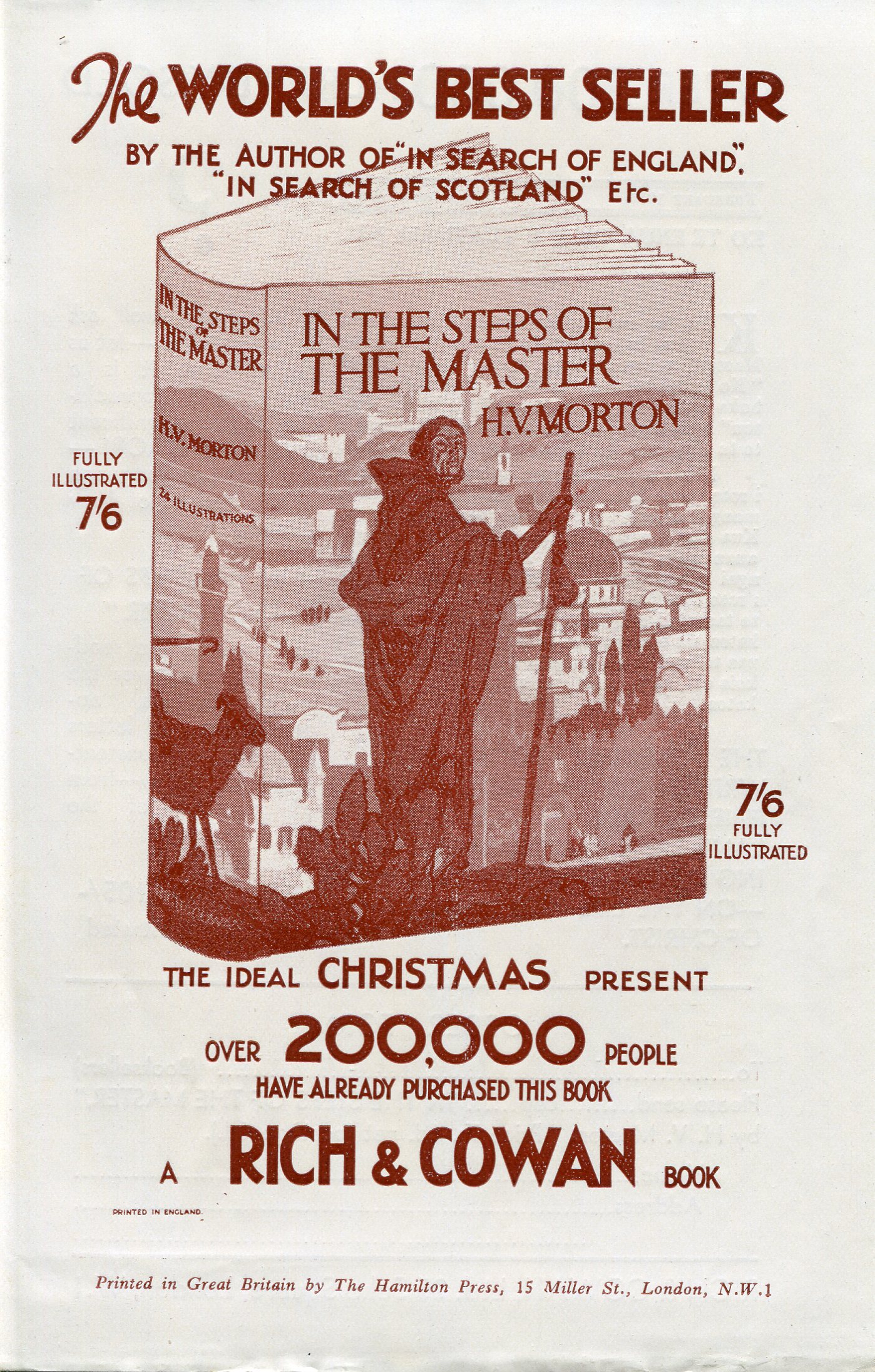
The front of this single sheet of paper is an advertisment for HVM’s best selling, “In the Steps of the Master“, published in October 1934, which it describes as “The World’s Best Seller” and suggests, at 7/6 (seven shillings and sixpence – that’s 37.5 pence in today’s currency), it would make the ideal Christmas present. It also features a retouched, monochrome reproduction of EA Cox’s original cover and informs us that already, only a few months after publication, it has sold a fifth of a million copies.

Interesting enough you would think, but it was the reverse of the flyer which really grabbed my attention.

In Search of Ireland flyer p 2

On the face of it, just a mundane order form, telling readers where to send their postal orders to secure that festive gift; but on closer inspection there is a review of the book which is of particular interest:

In Search of Ireland flyer p 2 crop

This review of “In the Steps of the Master” is written in Maori!

Being nothing if not obsessive, I transcribed the text:

February 1935                                                      Te Marama Rua o

KO TE ENUA APU E TUATUA NEI

Kua tae mai i te tima meile i topa akenei tetai buka ou “Ko In the Steps of the Master” te ingoa Papaa, ko te ingoa Maori “Ko te rua tapuae o e Pu”. Kua tataia tei buka e tetai tangta Beritane “Ko H.V. Morton” tona ingoa, na teia buka i akakite mai i te tu o te ingoa na eia buka i akakite mai i te tu o te enua ko Kanaana ou i teia tuatua.

Kua roa tona aerenga na roto i te enua e i roto i tona buka kua tata aia i te au mea e manganui tana i kite ana e i akarongo katoa. Kua aere atu aia ki Ierusalem ki te ngai anau anga o Iesu, ki Nazareta e ki te au ngai e manganui tei kite tatou i te au ingoa i roto i te Tuatua Tapu. Kua aere atu aia i te tautai ki runga i te roto i Galilea e kua kite katoa aia i te tangaa ravarai tei tautai i te pae tai mei te au tangata Cook Islands te tu, koia oki, te rave nei ratou i te rama e te auri katoa.

… But, unsurprisingly, it meant little to me. So I turned, in hope, to an online translation service, and discovered Google have recently included Maori in the list of languages it features. With a smug smile of satisfaction I entered the text and pressed “translate” and, hey presto!:

Have come from a team meile past a recent book your “In the steps of Master of the “name conflict, the English name” The two steps you Pu “. Has written a book tangta Beritane” The HV Morton “his name, in this book reveal the name of the stand and he books reveal the standing of the country and Canaan your Tairiiri.

Has his ways in the country and in his book he wrote the many things he saw his faith as a whole. Approached He Ierusalem to where Jesus’ birth, and Nazareth to the where we see many of the names in the Scriptures. He approached the fishing on Lake Galilee and found All he has to use all the fishing sites from coast humans Cook Islands stand, that is, they do the candle bar.

So, there we have it, as clear as mud. To be honest I think I had a better chance of understanding the original!

But even without being able to understand the full meaning of the text, it still gives a perspective on HVM’s immense appeal at the time and remains for me a fascinating piece of Mortoniana. It also provides a small snapshot of Morton’s life at a time of considerable change for him as, although the book containing the flyer is published by Methuen, the advertisment is for a book published by Rich and Cowan, to whom Morton had transferred his allegiance in 1933. They continued to publish his works until 1937 when they suffered bankruptcy, at which time Morton was persuaded to return to Methuen once more.

In the unlikely event that any readers are familiar with the Maori language I would be very grateful if anyone was able to cast any further light on this unique review. Not least because I would dearly love to know what it means to “do the candle bar” – it sounds like fun!

Niall Taylor

This article was originally distribued as HVM Literary Notes – No.127

2 Comments

Filed under Book reviews, HV Morton

“What I Saw in the Slums” … a little known aspect of HV Morton

In 1933 HV Morton’s writing appeared to undergo a sea-change with the publication of a little known volume called “What I Saw in the Slums“. While reviewing this work for the online magazine Albion, I became fascinated by what might have prompted this change of heart. Why would a writer who, up to that time, had made his fame and fortune chiefly by writing uplifting travelogues suddenly take it into his head to turn instead to some of the worst, most deprived areas of urban England and lay bare what he found there at the height of the Great Depression.

The article below is not the review but is a second piece which resulted from my musings about the change of direction HV Morton appeared to have taken. I am most grateful to Peter Devenish and Kenneth Fields for answering my enquiries on the matter as well as to the authors of Morton’s biographies – “The Life of an Enchanted Traveller” by Kenneth Fields and “In Search of HV Morton” by Michael Bartholomew – for helping me weave a few loose threads into a vaguely coherent whole and construct, to my satisfaction, the story of an important period in the life of HV Morton.

Additional information was obtained from “Writing Englishness: 1900-1950” edited by Judy Giles and Tim Middleton.

§

The cover of "What I Saw in the Slums"

The cover of “What I Saw in the Slums”

Anyone who has encountered the works of HV Morton, even briefly, will probably think of him as a chronicler of the brighter, more positive aspects of British life between the wars, with his various travelogues of England, Scotland, Wales and Ireland. If any criticism is to be made of his works it is his tendency to skirt around the harsher realities of life – he liked to keep things light-hearted. Anyone delving further into his background will come to realise that, although his views were kept largely private, Morton’s politics were distinctly conservative and right-wing.

Nothing in life is simple of course and sometimes, just when you think you know all there is to know about someone, they can still surprise you. Morton produced his early travelogues during ten fruitful and, initially, happy years spent working at the Daily Express newspaper, owned by Lord Beaverbrook. When Morton first joined the Daily Express in 1921 Beverly Baxter, who had been responsible for head-hunting Morton, reported he had been warned, with ominous foresight, by Morton’s previous editor at the Evening Standard, that his new recruit “… was gifted, but would give me trouble” [See HVM Society Snippet – No.146].

Slums 1Slum Playground for the “Coming Generation” – one of the photographs by James Jarché

Nearly a decade later, at the start of the 1930’s this prediction began to come true. Considerable personal success for Morton and an increasingly turbulent home-life started to drive a wedge between journalist and paper. Relations began to cool between him and Baxter, by then Editor in Chief, even though ironically it had been Baxter himself who had first encouraged Morton to begin his journeys around Britain, even going so far as to suggest the title In Search of England, thereby playing a large part in establishing the very fame which was now forcing them apart.

At the same time a rival paper, the Daily Herald – left-wing organ of the British Labour Party and Trades Union Movement and almost the polar opposite of Beaverbrook’s highly conservative Daily Express – was trying to improve its image. Owner, Ernest Bevin, and new publishing partners, Odhams Press, were striving to move the publication “up-market”, make it more competitive and put it on a firmer financial footing. One of the means they employed was to recruit star reporters (for lucrative salaries) to the staff, and so it was that HV Morton’s itchy feet led him in this unexpected direction in March 1931.

On a more personal level, according to biographer Kenneth Fields, Morton seemed to feel a need to step out of his comfort-zone and “… could no longer ignore the terrible poverty and unemployment that was evident throughout Britain. Unlike the Express, which he believed had become obsessed with rich celebrities, working at the Herald now gave him the opportunity to write about the life of the working-man“.

The first product of this unlikely pairing was conventional enough; another in Morton’s series of travelogues, eventually published in book form as “In Search of Wales“. What followed next though was a completely radical departure for Morton. “Labour Party Pamphlet VII” grew out of a series of columns he had been commissioned to write for the Herald in 1933 and was published under the title “What I Saw in the Slums“.

To hold a copy of “What I Saw in the Slums” in one’s hand is, quite literally, to hold a piece of history. This pamphlet was never modernised or re-published in the way that better known, later texts such as Priestley’s “English Journey” or Orwell’s “Road to Wigan Pier” were, so its very pages are part of the period about which they were written.

Understandably therefore, particularly since it was published in soft-back, very few copies have survived to the present day, despite the weighty feel of the publication suggesting it was printed on good quality paper. This makes it one of the rarest, and most collectible of all Morton’s works, and it was my “Mortonian Holy Grail” for a number of years before I finally bagged a copy on E-bay, thanks to a heads-up from avid Mortonite, John Baker.

Slum room“This Single Room is the Home of Husband, Wife and Three Children” –
reads the caption to this photograph of some of the
appalling conditions witnessed by Morton and Jarché

When it finally arrived, my copy was so fragile that I had to repair it with archive-quality adhesive tape and then labouriously scan the entire volume onto my computer in order to produce a facsimile reading copy. After all this, at long last I finally managed to read it and it didn’t disappoint – the wait was well worth it!

§

My review of “What I Saw in the Slums” for Isabel Taylor’s online magazine Albion was published a few months ago in the ten year anniversary edition, and can be found about half-way down this page. I hope to be able to publish it in full on this blog in a few month’s time.

With best wishes,

Niall Taylor 20 August 2014

(This article was originally circulated on 15 February 2014, as HVM Literary Notes – No.121)

3 Comments

Filed under Book reviews, HV Morton, Travel

A Canterbury Tale, by Elisabeth Bibbings

This piece was originally distributed as HVM Society Travellers’ Tales – No.26

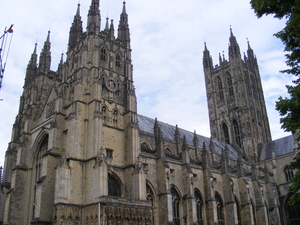
Canterbury Cathedral

Canterbury Cathedral

Looking down from an upstairs café window at the entrance to the Cathedral precinct, I amused myself imagining the crowds of a past time – the raucousness and smells of mediaeval Canterbury, the poke bonnets and stagecoaches of the rather more genteel Victorian era (I had just finished re-reading George Eliot’s “Middlemarch“).

Seated at the café table with my long-suffering husband and me, was a man with dapper moustache and a notebook, his quick eyes observing everything he saw. The waiter didn’t seem to notice the pipe smoke, and the other café users seemed to be unaware of his presence.

We left the café and went through the archway to the Cathedral. Our companion’s eyes lit up at the soaring towers and he reminded me of how he had visited the heights of Bell Harry tower in 1939. He seemed scandalised when we were asked to pay admission, but when I explained that it costs £18,500 a day to run the Cathedral, he admitted maybe there was a need for it.

Once inside, the soaring heights of the nave drew our thoughts heavenwards. As the hour struck, a clergyman ascended the pulpit and led a short prayer for the troubles of the world.

stained glass

My friend, nursing his trilby (and glaring with outrage at a young man who had kept his cap on in ignorance), pointed out window after window of mediaeval stained glass, the deep blue colouring the pavement below. It was impossible to take in all the details, as Bible story and saints’ tale were depicted in miniature panels on windows stretching higher than we could see.  Only the mason and conservator would ever know the details of these wonderful windows.

We entered the shrine of the Martyrdom, and a guide launched into an enthusiastic description of how well Becket’s death was chronicled as he fell in the presence of the most literate men of the day – the monks. A recent sculpture emphasises the violence and brutality of the murder. Mr. Morton capped the guide’s tales with accounts of his own.

Well covered with Becket’s gore and smarting from King Henry’s penance, we moved on into the Crypt. Here was peace and the silence of centuries long gone by. At the back was a treasure house of secure glass cases, and I was hurried along to see the chalice and patten used by Hubert Walter on crusade in the Holy Land. It was an amazing artefact. “There is not a place to which this chalice travelled in Palestine that I do not know,” Mr. Morton commented. I also saw the mazer mounted with a yellow gemstone reputedly from Becket’s shoe, which came originally from the almshouses of St. Nicholas, Harbledown.*

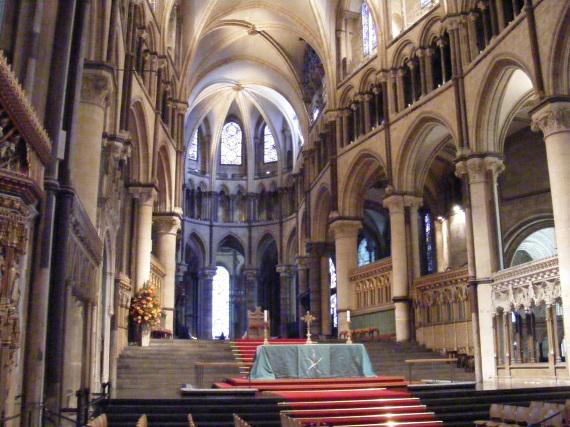
We ascended (never did a Cathedral have so many different levels!) to the Quire.  Here delicate pointed arches give way to the architecture of Byzantium. Flame-coloured flower arrangements reminded us that the Sunday before was Pentecost. We sat and savoured the scene.

Interior

On further exploration, we found the tombs of Bolingbroke (Henry IV) and the Black Prince. We learned that Henry, because he was not a prince in his own right, (being the son of John of Gaunt) was anointed with holy oil (reputed to have been given by the Virgin Mary to Becket) to justify his being crowned King, after deposing Richard II.

By then, our feet were aching but our companion seemed indefatigable. He kept peering into corners, walking into chapels, saying “You must see this” and showing us ancient wall paintings or quaint memorials from the Kentish Regiment. Eventually I managed to coax him outside and we ended up, as every good visitor must, in the Gift Shop. Here, I left him explaining to my husband how in bygone ages, the shops of Canterbury sold little lead medals as souvenirs whereas now one could buy books, CDs, teatowels, rubber ducks complete with bishops’ mitre . . .

When I returned from making my purchases, my husband was alone.

Where’s Mr. Morton gone?” I asked.

I don’t know,” he replied.  “He said something about going back into the Cathedral.

Maybe if you go there, you will find him too, and he will enlighten your visit as he did mine.

Elisabeth Bibbings, Northamptonshire, England 12 July 2014

*  “I Saw Two Englands“, ch. 3, section 5.

Leave a comment

Filed under Religion, Travel

D-day recollections

Originally distributed as HVM Society Verses – No.27
on 6 June 2014

Supermarine Spitfire

… like an angel’s shining sword, the sylphine Spitfires wait…

During some of the darkest days of world war two, HV Morton was on look-out duty from the church tower of his local village of Binsted, Hampshire, where he commanded the Local Defence Volunteers, when he wrote:

“… it is a still night. And now the clouds part and the moon shines through, casting green shadows so that I can see the little hamlets lying below among haystacks and fields. The lime-washed cottages shine like snow in the moonlight, little cottages with front gardens bright with Canterbury bells, geraniums, and poppies; and I think that a more peaceful bit of old England could not be found than this village of ours. Yet every cottage holds an armed man. If I rang the bell now they would come running out with their rifles, ready to defend their homes. Such a thing has not happened in Britain since the Middle ages… My own point of view, and, indeed, it is that of all the farmers, the farm labourers, and the cowmen who compose our local L.D.V., is that, should the rest of Britain fall, our own parish would still hold out to the last man.”

(with grateful thanks to the Trove archive)

Later, in 1944, the tide was beginning to turn, and seventy years ago today the largest invasion fleet in history sailed from Southern England, during a fortuitous break in the weather, to establish a series of beach-heads in Northern France – the Battle for Europe had begun.

HV Morton Society member Mike Bassett, of South Africa, has written a series of poems about the war years he spent on the Isle of Wight, when young, as he witnessed events which included the Battle of Britain and VE Day, as well as the D-Day invasion of Normandy. Mike recalls, “… what a sight it was to see the Solent absolutely jam-packed with warships etc., and then – come June 6th – not a single ship in sight. It was eerie and utterly memorable and I am proud that I was a witness to it all.“.

I thought I would share one of them with you on this, the 70th Anniversary of the D-Day landings.

With best wishes,

Niall Taylor, Glastonbury, Somerset, England

§

VIGNETTES OF BOYHOOD
1 – 1940 and on

by Mike Bassett

Portsmouth: Sunday, Sept., 15th 1805. At day weighed with light airs Northerly”. Extract from Nelson’s Diary written aboard the Victory before Trafalgar.

Units of the Home Fleet put into Spithead – August, 1940.

A clear, full moon and cloudless sky,
And in the gathering gloom,
Across the still and limpid sea
The silent warships loom.
The signals flash from bridge to bridge,
Like tiny, glowing sparks:
The mighty turbines slowly die –
The giants rest in the dark.

Then the wailing of the sirens,
And the deep, low drone of ‘planes,
The searchlights and exploding bombs,
And Portsmouth crowned in flames:
And etched against the ghostly light
Of a gently falling flare,
The Victory’s masts rise gaunt and black
In the brilliant, silver glare
Of another Trafalgar – here.

The stench of a burning city;
And the rolling banks of smoke,
As a tanker slowly settles,
And her clawing seamen choke,
And on the beach next morning,
‘Mid the charr’d and oily dross,
The body of a merchantman
Tattooed with a rose and cross.

The joy of search – and finding,
A burnt-out One-O-Nine,
The stab of fear as the Stukas struck (more)
Like screaming hawks in line.
Long vapour trails that smudge and fade
In the blue and lovely skies
Where, like an angel’s shining sword,
The sylphine Spitfires wait:
The swarming blocks of bombers,
That scab the sky with mange,
And stepped-up high in the warming sun
The glinting fighters range:
Or standing high on the roof-top,
By the “Grecian” statues tall,
To watch the raucous Flying-Bombs
In sudden silence fall.
Or diving, in a cricket match,
On coils of rolled-up wire,
As a Junkers roared at tree-top height,
Machine-guns blazing fire.

And later still, the exuberant Yanks,
Who came from “Over there” – “swell!”
The Memphis Belles who gave us gum –
And gave their lives as well.
The massed armada of shipping
On D-Day minus One;
And the heavy, foreboding silence
That descended when all had gone
To meet their fates on the beaches
And the white-hot cauldron of Caen.

And now and then, through tears and cheers,
“A nightingale sang in Berkeley Square”,
But where, O where have the people gone.
And where, O where the years? (end)

3 Comments

Filed under Remembrance

Call me a cab

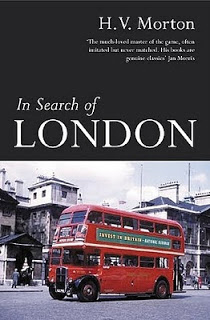
In Search of London 2008

While reading HV Morton’s 1951 “In Search of London”, reader Peter Dron came across this quote in section 6 of chapter 10:

The men who drive the taxi-cabs of London are naturally a race apart. I have known them, and have admired many of them, for years. Some of the old stagers used to drive horse cabs, but that generation is now vanishing…

The other day I struck an old driver who might have been a thin relative of Bairnsfather’s “Old Bill”. I sat looking at the nape of his aged neck, his greying hair, the way he dodged in and out of the traffic and wondering what age he was. When we parted I gave him an unusually large tip because I liked him and because he was old. He looked at the money in the palm of his hand, smiled and winked at me and said:

“Thank yer Guv’nor. Don’t often meet a toff these days, and that’s a fact!”

What a strange conversational throw back to a dead age! He remembered the age of “toffs”, “swells” and “nobs”.

“You see this ‘ere,” he said, still gazing at the money. Do you know what I’d rather ‘ave than this ‘ere? I’ll tell yer… a blinkin’ fat rump steak and a pint o’ porter.”

He then leaned towards me and deplored the age in wich we live. He was an old snob. He loved toffs. He liked “a gentleman”. You could always tell a “real gentleman” from the other kind. Not ‘arf you couldn’t! But nowadays, driving a “keb” in London, blimey what a queer collection of odds and ends you meet. Not ‘arf you didn’t! But in the old days… Ah, the old days, when you could get a rump steak and a pint o’ porter… them was the days, guv’nor, them was the days, and we shan’t see them again. Not ‘arf we shan’t…

And away he went.

Peter was reminded of an article he had written for the Telegraph in 2001 about the London taxi (the TX1 apparently) and, in particuar, those mysterious little green huts which act like docking stations – little taxi Shangri-Las – across London where black cabs and their drivers congregate to be among their own kind for a while, out of the public eye. Had his wish been granted, it is likely that Morton’s driver would have enjoyed his “blinkin’ fat rump steak and a pint o’ porter” in one of these.

IMG_4330 small

Peter informs us they are something of an endangered species, with considerable provenance and great historical and cultural significance; while at the same time possessing a rather amusing air of having been dropped down, more or less at random, from somewhere above, just like Dr Who’s police box.

They are certainly captivating and when I came across one during a recent family visit to the capital something told me I had to photograph it, and I’m glad I did. Having read Peter’s article I heartily agree with him – it’s rather splendid and surprising that so many of those cabmen’s huts have somehow survived wars and ‘planners’ – not ‘arf it ain’t!

Niall Taylor 20 May 2014

4 Comments

Filed under Connections, HV Morton, Quotations

Pope Pius XII

Pope Pius XII (image courtesy of wikipedia)

Pope Pius XII
(image courtesy of wikipedia)

I am just reading HVM’s book “A Traveller in Rome” – AGAIN, and with much pleasure – and am interested in his views on Pope Pius XII which are very positive. This pope was very much defamed after the war – quite wrongly, but Morton published this in 1957! Possibly “they” decided to have a go at the Pope after this date – for what  he was supposed to have not done during the war. As it happens he did a great deal but had to be quiet about it. I can’t imagine Hitler taking much notice of anything he had to say about the situation, he would simply have shut him up one way or another.

Bearing that in mind I have put together the short piece that follows. Really, surely this should go on TV  like Bradshaw’s journeys by Michael Portillo on the train round the country, which are very interesting – but HVM knocks spots off old Bradshaw!

I once started to write a travel book of my journey round the Middle East and some time later read HVM – frankly I threw my stuff in the bin. The amount of sheer hard work and research – before Ye Internet – combined with his wonderful writing skills and connections to people wherever he went is, to me, genius.

§

HV Morton, the celebrated travel writer, states in his book “A Traveller in Rome”, published in 1957:

There probably has never been a Pope who is more certain to be canonised that Pope Pius XII and the stories I heard about him made me anxious to see a man who will one day be numbered among the saints”.

The cover of "A Traveller in Rome"

The cover of “A Traveller in Rome”

Morton obtained a ticket for an audience at Castel Gandolfo, the Pope’s summer home, among thousands of others. His holiness appeared on the balcony, seated on a red and gold chair, an elderly, frail white haired man, wearing gold rimmed spectacles and  “radiating holiness”.

Even if I been unaware of his ascetic lifestyle and his saintliness,” HVM wrote, “I should have felt this. He is a thin aristocrat whose hands are of the thin and attenuated kind that El Greco loved to give to his saints. His face is slim and sallow, his eyes dark and deep set. He is so upright and precise in his movements that it is difficult to believe he is eighty years old.”.

HVM goes on to describe the Pope in more detail: He speaks eight languages, he says, and was the first Pope to have flown, to descend into a mine and to visit a submarine. In 1917 he carried to the Kaiser the offer of Benedict XV to mediate in the first World War. He knew Hitler before the last war and he was elected in 1939, on his birthday, when he was sixty three years old. An unfortunate time to become Pope indeed!

Morton does not comment on the Hitler connection which, of recent years, has been the cause of so much defamation of this Pope since, in 1957 – when “A Traveller in Rome” was published, the campaign to condemn Pius for not sorting Hitler out had not yet begun. At this audience the Pope gave a short speech and a blessing in several languages and clearly was hugely popular and much loved.

HVM later had a private audience with his holiness. It was a simple ceremony in which Morton received a blessing and, while down on one knee, found himself fascinated by the beautiful scarlet velvet papal shoes peeking out from beneath the hem of the Pope’s spotless white soutane. Again HVM states his belief that he was in the presence of a truly holy man, who led a frugal and ascetic life and who loved birds, keeping two pet canaries which he allowed to fly around his apartments in the Vatican.

With hindsight, looking back from the year 2014 at Morton’s pleasant and  fascinating account of his meeting with Pope Pius XII sixty years ago, it is relevant to mention the unjustified attacks this Pope has been subjected to since that time.

From around 1963 Pius XII has been accused of being a friend of Hitler and not speaking out against the Holocaust – this is not the place to discuss these accusations which, in any case, have already been strongly refuted. It is difficult to know what Hitler would have said or done had the Pope made a public denunciation of him anyway, but it is hardly likely that he would have taken any notice.

In the event Pius XII did much to help the Jews, as well as many other victims of the war, in a quiet and – of necessity – secret way for which he should be thanked instead of defamed. When HV Morton met his holiness in the 1950s, he perceived Pius XII as a man of goodness, holiness, courage, intelligence and concern for all. If negative and defamatory things were being said about the Pope in Rome at that time surely, as a writer who missed little in his travel books and researched his material thoroughly, HVM would have been aware of it.

Barbara Green, West Yorkshire

Leave a comment

Filed under Book reviews, Religion